Resume strategy · 15 minute practical guide
How Long Should a Resume Be? A One-Page vs. Two-Page Decision Tree
Choose one or two pages by relevant evidence, career stage, readability, and application rules—without shrinking the resume to satisfy a myth.
The answer first
Use the shortest resume that preserves your strongest relevant evidence.
For a typical U.S.-style resume, one page is a strong default for students and many early-career candidates. Two pages are reasonable when the second page adds target-relevant experience, projects, leadership, credentials, or results that would otherwise disappear. Years of experience can guide the first draft, but they do not decide the answer by themselves.
- One page when the case is complete and readable
- Two pages when page two adds relevant proof
- Never shrink the document into visual friction
- Follow special application rules before general advice

The one-page versus two-page decision
Ask what the extra space proves—not how many years you have
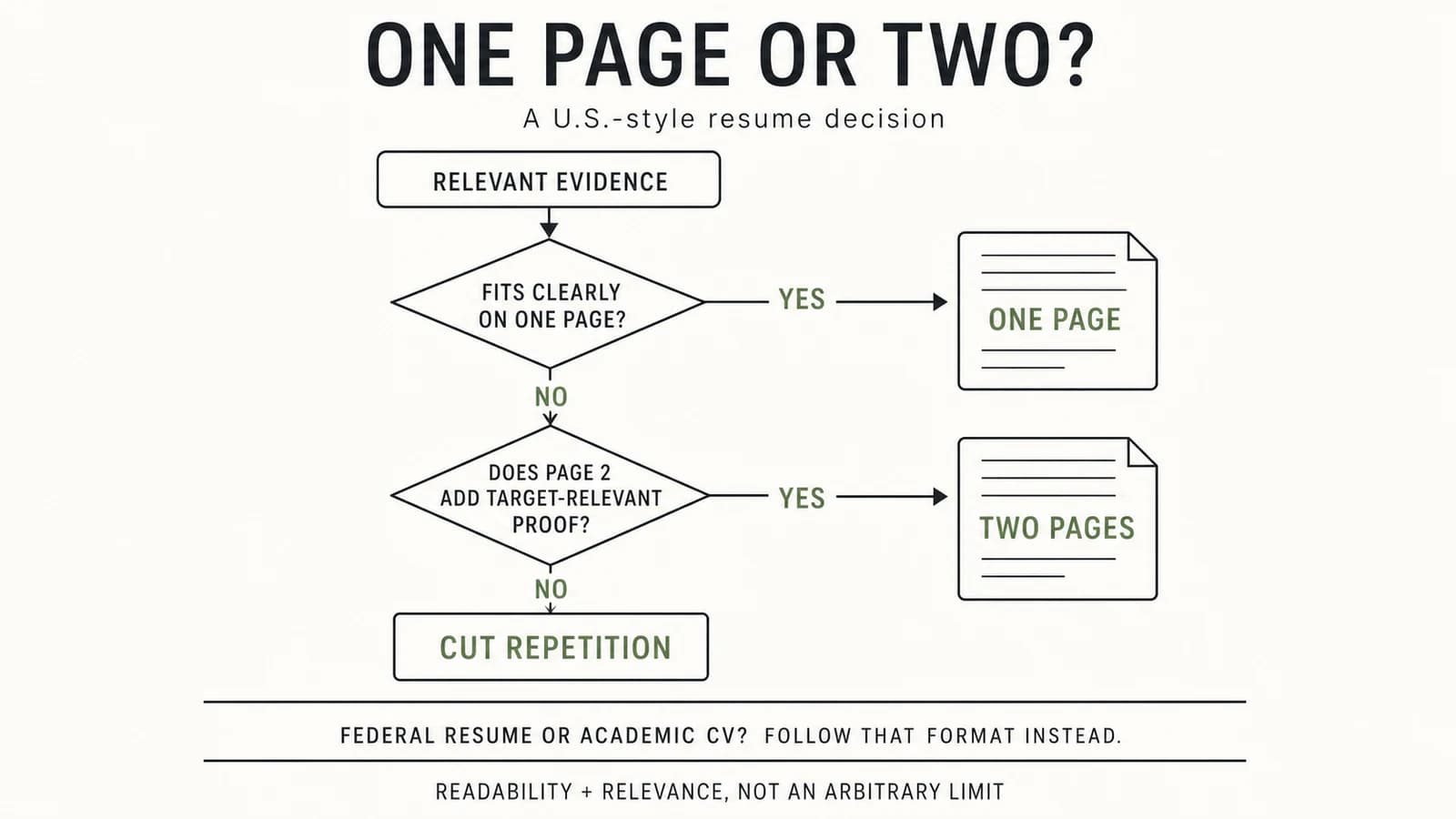
- 01
Are you writing the right document?
Yes: Continue if this is a U.S.-style resume for a typical industry role.
No: Follow the application’s rules for a federal resume, academic CV, portfolio, or country-specific document.
- 02
Can the relevant case fit clearly on one page?
Yes: Use one page. Do not add a second page simply to look more experienced.
No: Continue. Do not shrink type or margins before testing the evidence.
- 03
Does page two add target-relevant proof?
Yes: Use two pages and make page one the strongest independent case.
No: Cut repetition, unrelated history, generic language, and unsupported lists.
- 04
Is the second page substantially used?
Yes: Keep two pages if the page remains selective and easy to scan.
No: Rebalance the edit or return to one page; a few orphaned lines rarely justify page two.
Swipe horizontally to follow the one-page versus two-page decision tree
“Relevant” is doing most of the work
A second page is not justified because the candidate has more facts. It is justified when those facts make the target case stronger: a distinct leadership challenge, a technical project, required credentials, meaningful career progression, or an older achievement that is still directly relevant.
The same person may use one page for a focused role and two pages for a broader or more technical role. That is not inconsistency. It is the result of tailoring one verified career record to different evidence needs.
A starting point, not a law
Use career stage to begin the edit, then let relevance decide
Swipe horizontally to compare resume-length starting points.
| Career stage | Starting point | Protect this evidence | Consider two pages when |
|---|---|---|---|
| Student or recent graduate | Usually one page | Relevant education, internships, substantial projects, research, activities, and skills with proof. | A second page carries required or unusually substantial technical, clinical, research, publication, or project evidence. |
| Early career | Usually one page | The strongest recent roles, target-relevant projects, and evidence of growing ownership or outcomes. | Cutting to one page removes directly relevant work, credentials, or portfolio-grade project depth. |
| Mid-career | One or two pages | Recent progression, representative achievements, role scope, and the capabilities the target actually needs. | Several relevant roles or projects show distinct evidence that cannot be combined without losing meaning. |
| Senior or executive | Often two pages | Leadership scope, decisions, transformations, business outcomes, and selected earlier evidence that proves depth. | Page two adds material leadership or domain proof—not a full archive of every responsibility. |
These are editorial starting points for a typical U.S. industry resume, not measured hiring thresholds. The application, profession, country, and document type can change the answer.
When one page is stronger
Use one page when compression improves the signal
Signs one page is enough
- Your strongest evidence comes from a small number of recent roles, internships, or projects.
- Older work mostly repeats the same duties or does not support the target.
- Education and projects can be explained without long technical, clinical, or research detail.
- The page remains readable with ordinary typography, spacing, and margins.
- A reader can understand direction, level, required capabilities, and proof without asking what was cut.
Warning signs the one-page goal is hurting
- The type, line spacing, or margins feel compressed before the content is even read.
- Role titles, employers, and dates are shortened until the chronology becomes unclear.
- Relevant achievements disappear while generic skill labels remain.
- Bullets lose the action, scope, or outcome needed to understand their value.
- You use two narrow columns only to satisfy an arbitrary one-page rule, then the reading order breaks.
Forced one page
Focused one page
When the second page earns its place
Use two pages when depth protects the decision
| Page one must establish | Page two may deepen | Page two should not become |
|---|---|---|
| Target direction and professional level | Earlier progression that makes the level credible | A second introduction or repeated summary |
| The most relevant recent role and strongest outcomes | Distinct projects, leadership cases, or technical depth | A duty archive for every prior role |
| Required capabilities that are already supported | Additional evidence, credentials, publications, or selected education | A longer unsupported keyword inventory |
| A clear reason to keep reading | Context that answers important evaluation questions | A half-empty page created by one orphaned section |
Do not hide the best evidence on page two
A reader may not inspect both pages with equal attention. Put the target role, relevant level, strongest current proof, and critical requirements on page one. Page two should reward continued reading, not repair a weak opening.
Continue section headings consistently, keep the same header or a restrained name-and-page marker, and avoid splitting one short role across the page break when a cleaner break is available.
Edit the evidence budget
Cut repetition before you cut proof
Swipe horizontally to compare resume cuts.
| Content competing for space | Editing decision | Why |
|---|---|---|
| Repeated duties across similar roles | Keep the strongest or most recent proof; compress older repetition into a short scope line. | A second version of the same duty rarely adds a new hiring signal. |
| Older work unrelated to the target | Remove it, or keep employer, title, and dates in an Earlier Experience line when chronology matters. | History is not equally relevant just because it happened. |
| Long skill inventories | Keep the accurate target-relevant tools and methods; remove obsolete, basic, or unsupported terms. | Findability improves only when the list helps a person understand capability. |
| Generic summary language | Replace adjectives with a short identity, target, scope, and evidence statement—or remove the section. | A vague summary consumes the most valuable space without proving fit. |
| Every project, publication, or certification | Select the items that strengthen this application and link to a portfolio or complete list when appropriate. | The resume is a targeted summary, not the only record of a career. |
| References and “references available” | Leave them off unless the application explicitly requests them on the resume. | They use space without advancing the initial evidence case. |
Keep a private master resume longer than the submitted version
The evidence removed from one application does not have to disappear from your career record. Keep full roles, projects, metrics, collaborators, dates, and artifacts in a private master resume. Build the one- or two-page submitted version from that source so a future target can restore evidence without reconstructing the past.
Special documents override general advice
A federal resume, academic CV, and international application may use different rules
| Document or context | Length decision | What controls |
|---|---|---|
| Typical U.S. industry resume | Usually one or two pages | Target relevance, readability, career evidence, and application instructions. |
| Federal resume through USAJOBS | Currently two pages or fewer | USAJOBS and the specific announcement. The current limit took effect in 2025, so older advice may be obsolete. |
| Academic CV | Often longer and not governed by the one-page resume convention | The discipline, institution, application, and need to document research, teaching, publications, and service. |
| Graduate-school or research application | Follow the requested resume or CV format | Program instructions and discipline-specific expectations. |
| Application outside the United States | Country and employer conventions vary | The local meaning of “CV,” privacy norms, photo expectations, and the application’s explicit instructions. |
Reviewed July 30, 2026. USAJOBS currently states that federal agencies accept resumes of two pages or fewer through the system. Always recheck the live announcement and official instructions before submitting.
The rule changes with the evidence
Three fictional candidates reach different answers
Complete worked example
Avery Patel
Recent computer science graduate → Software engineering role
Fictional teaching example. Projects, internship, and application context are illustrative.
Evidence
One internship, two relevant projects, education, and a focused technical skills set.
Decision
One page
Why
Page two would add coursework and minor activities, not stronger engineering proof.
Complete worked example
Elena Brooks
Operations manager with nine years of experience → Regional operations leadership
Fictional teaching example. Employers, scope, and outcomes exist only to demonstrate the page decision.
Evidence
Three progressive roles, multi-site scope, process changes, team leadership, and distinct cost and service outcomes.
Decision
Two pages
Why
Page two adds relevant progression and a second leadership case. It is not a repetition of page one.
Complete worked example
Daniel Hart
Senior platform engineer with fourteen years of experience → Focused reliability engineering role
Fictional teaching example. Daniel’s narrow target makes selection more important than chronology volume.
Evidence
Deep recent platform evidence, while several older roles repeat general software-delivery responsibilities.
Decision
One or two pages after testing
Why
Fourteen years do not force two pages. Daniel keeps page two only if it preserves distinct reliability or leadership proof.
A final document check
Make the chosen length readable in the actual PDF or DOCX
- 01
Use readable type and spacing
Choose a conventional text size and enough line spacing for sustained reading. Do not use tiny type to win a page-count contest.
- 02
Keep practical margins
Recover space through content decisions before compressing the page edge. Inspect printing and PDF rendering.
- 03
Control page breaks
Avoid orphaned headings, one-line second pages, and confusing role splits. Keep employer, title, and dates together.
- 04
Preserve the first-page hierarchy
Target direction, level, required capabilities, and strongest proof should be findable before page two is needed.
- 05
Test extraction and links
Copy the final text into a plain-text editor, check its order, reopen the renamed file, and test every relevant link.
- 06
Follow the application
A stated page limit, file type, required section, or document type outranks generic resume advice.
Resume length FAQ
Short answers without a universal page-count rule
Should a resume be one page or two pages?
Use one page when it can show the target-relevant evidence clearly and completely. Use two pages when a second page adds meaningful proof that would otherwise be cut or made unreadable. Relevance and readability matter more than obeying an arbitrary universal limit.
Is a two-page resume too long?
Not when both pages are selective, easy to scan, and relevant to the target. A weak two-page resume usually contains repetition, obsolete detail, or a nearly empty second page. A strong two-page resume uses page one for the clearest case and page two for supporting depth.
Can an entry-level resume be two pages?
It can, but most recent graduates can make a stronger one-page resume by selecting relevant education, projects, internships, activities, and skills. A second page should add substantial target-relevant research, technical projects, publications, clinical experience, or another required form of proof—not padding.
Can a senior professional use a one-page resume?
Yes. Seniority does not create a two-page requirement. A senior candidate with a narrow target and a focused recent history may make a complete case in one page. The test is whether important scope, leadership, and outcomes remain visible and credible.
Should I shrink the font to keep my resume to one page?
Do not solve a content problem with unreadably small type, crowded margins, or compressed line spacing. Remove repetition and low-relevance detail first. If directly relevant evidence still does not fit clearly, use a second page or a more appropriate document format.
How long should a federal resume be in 2026?
USAJOBS currently limits federal resumes submitted through its system to two pages. The job announcement and USAJOBS instructions control, so verify the current requirements for the specific application rather than relying on older federal-resume advice.
Editorial method
Reviewed July 30, 2026 for current U.S.-English guidance. University career centers support one page as a common recent-graduate default and two pages for more extensive relevant history. Current USAJOBS guidance supplies the federal two-page requirement. Reddit discussions are treated as qualitative evidence of the recurring conflict, not as a hiring benchmark.
Sources reviewed
- UC Davis Career Center: resumes
Current one-page and two-page starting guidance plus readability standards.
- UC Davis: resume versus CV
Purpose and length distinctions between a resume and academic CV.
- USC Career Center: resume format
One-page student default and two-page guidance for extensive experience.
- USAJOBS: federal resume page limit
Current federal two-page limit and application-specific content requirements.
- r/resumes: one-page rule discussion
High-engagement qualitative debate about relevance, readability, and two-page resumes.
- r/resumes: current one-or-two-page question
Recent community discussion showing the question remains active in 2026.
Choose a template after you know how much evidence must survive
Compare real one-page and one-to-two-page formats by role, density, section order, and readability—then inspect the actual PDF and DOCX output.