
Resume strategy · 16 minute practical guide

How to Explain an Employment Gap on a Resume—Without Oversharing or Making Anything Up

Decide when a career break needs context, protect private details, use truthful gap wording, and connect the timeline to current job readiness.

My Best Resume Editorial TeamPublished Updated

The answer first

Give only the context needed to make the timeline understandable.

To explain an employment gap on a resume, first decide whether the gap needs a resume entry at all. If it does, use accurate dates, a neutral label such as Career Break, and one brief line of context. You do not need to invent work, apologize, or disclose medical and family details that do not help someone evaluate your ability to do the job.

  • Use a neutral, truthful label
  • Keep private details private
  • Show real current evidence when relevant
  • Move quickly to readiness for the target role
A fictional professional returning from a career break and reviewing a resume timeline with recent work samples.
AI-generated editorial photograph. The person, chronology, and work samples are fictional; no medical record, family information, employer data, or hiring prediction is shown.

The first decision

Not every blank period needs a resume explanation

A resume is a targeted professional summary, not always a complete legal or background history. The application instructions control when a full chronology is required.
SituationResume treatmentReasoning
A short transition between jobsUsually leave it alone.Normal hiring and start-date timing may create a brief gap that does not confuse a selective resume.
A visible recent break of many monthsConsider a brief Career Break entry.One neutral line can keep the reader from guessing, especially when you are returning now.
Relevant education, freelance, volunteer, or project workList the real activity under its accurate label.This is evidence, not gap camouflage. Include it only when you can explain the work and dates.
An older gap before several strong recent rolesOften omit the explanation.Recent continuity and performance may matter more than narrating an old interruption.
An application requesting complete employment historyFollow the application exactly.A resume shortcut should not create inconsistent dates or missing information in a required form.
A gap tied to a sensitive personal matterUse a broad label or no resume detail.Relevance and privacy should guide disclosure; the resume does not need a personal case history.

The disclosure boundary

Explain the timeline without surrendering your privacy

The resume should focus on job-relevant facts. Personal health, caregiving, and family circumstances can often be described at a much higher level.

Health

“Personal Career Break” is usually enough resume context. You can state current readiness without naming a condition, treatment, hospitalization, or prognosis.

U.S. EEOC guidance restricts disability-related questions before an offer; this article is general information, not legal advice.

Caregiving

“Family Caregiving” can explain the period without identifying the person, relationship, diagnosis, or intimate circumstances.

Bereavement or family crisis

Use “Personal Career Break” or omit the explanation. You are not required to make grief part of your professional narrative.

Layoff

The accurate end date is often sufficient. If asked, explain the business event briefly and move to what you are targeting now.

Legal or safety concern

Avoid guessing from a general resume article. Employment, background-check, and disclosure requirements can vary; consult a qualified local resource when the facts could carry legal consequences.

The resume formula

Use label, dates, context, and present direction

A gap entry should be shorter than a job entry because it is there to orient the reader, not to manufacture a substitute role.

Simple pattern

Label
Career Break

Dates
March 2024–May 2025

Context
Family caregiving

Direction
Returning to operations

Before

2024–2025: I had to leave work because of serious family and health problems but used the time to become more resilient and improve many skills.

After

Career Break — Family Caregiving | March 2024–May 2025. Provided full-time family care; now returning to operations roles with current Excel and inventory-planning practice.
Why this works: The revision uses a neutral truthful label, removes private details and self-praise, and names present direction. The final phrase belongs only if the candidate can show the stated current practice.

Reason-by-reason examples

Use the least detail that answers the professional question

These examples are templates, not facts to copy. Replace the wording with an accurate description of your own situation or leave the entry out.
SituationPossible labelOne-line exampleLeave out
Family caregivingCareer Break — Family CaregivingProvided full-time family care; now available for a planned return to [target field].Medical details, the relative’s identity, or claims that caregiving was paid professional work when it was not.
Health or recoveryPersonal Career BreakTook a personal career break; fully prepared to return to [target role or field].Diagnosis, treatment, prognosis, or other private health information you do not want to disclose.
Layoff and job searchUsually no separate entryKeep the accurate end date. Use the summary only if a current transition needs context; show real recent projects, consulting, or education separately.A fictional consulting business, invented clients, or “professional development” with nothing specific behind it.
Full-time educationGraduate Study / Professional EducationList the verified program, institution, dates, and relevant applied work or credential.Calling coursework employment or implying the credential was completed before it was awarded.
Career transitionCareer TransitionBuilt current evidence through [specific project, training, volunteer assignment, or credential] while targeting [role family].A target title you have never held or a portfolio result presented as paid client work.
Travel or personal prioritiesPlanned Career BreakTook a planned personal break and am now returning with a focused target in [field].A long justification, itinerary, or forced claims that every personal activity created professional skills.
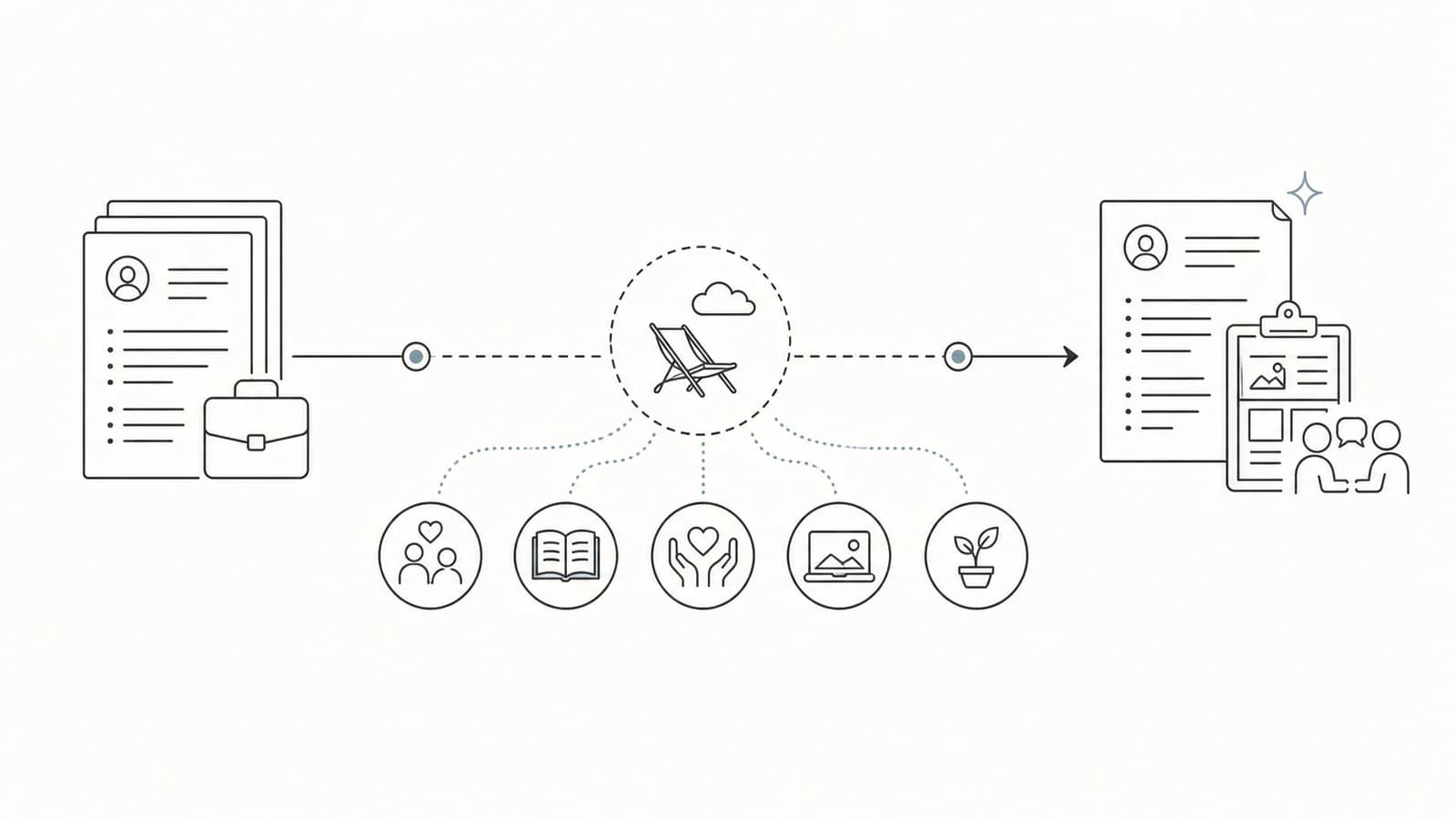
A conceptual career timeline showing prior work, an honest career break, optional real activities, and readiness to return.
AI-generated editorial illustration. The break remains visible rather than being disguised as employment; the exact labels and disclosure choices are explained in the HTML tables.

What happened during the break

List real activity only when it strengthens the application

You do not need to prove that every month away from paid employment was productive. If you did relevant work or learning, show it with the same factual discipline used for a job.
ActivityInclude whenEvidence to showLabel honestly
Freelance or consultingYou performed real scoped work for a client or customer.Deliverable, audience, method, dates, and outcome you can discuss.Independent Consultant, Freelance Designer, or the accurate service—not a larger fictional company.
Volunteer workThe responsibility is relevant or demonstrates current contribution.Organization, role, work performed, scope, and result.Volunteer role; do not imply employment or compensation.
Education or certificationThe program is relevant, verifiable, and sufficiently substantial.Institution, program, completion status, applied project, and awarded credential.Course, certificate, license, and certification are not interchangeable.
Independent projectIt creates an inspectable work sample related to the target.Problem, source data, process, artifact, limitations, and link when appropriate.Independent Project; do not present invented business results as client outcomes.
CaregivingThe gap needs context or the responsibility itself is relevant to the target.Usually one broad line; professional-style bullets are optional and should avoid inflated equivalence.Family Caregiving, not healthcare employment unless it truly was paid professional care.
Job searchingUsually not as a standalone resume entry.Show current relevant projects, learning, or volunteer work separately when real.Do not call ordinary applications “business development” or “market research.”

If the break also includes a career pivot, use the career change resume guide to separate transferable evidence from skills you still need to build.

Chronology

Use consistent dates and let the application control precision

Date formatting should improve readability without creating a misleading record.

Month and year

Best for recent roles and visible breaks because it makes the sequence clear: March 2022–October 2024.

Year only

Can work for older history or a resume consistently formatted at that level. Do not switch only one role to years to conceal a recent gap.

Overlapping activity

Show accurate concurrent dates. Part-time study, volunteering, freelance work, and caregiving may overlap without becoming one continuous job.

Current activity

Use Present only for activity that is truly ongoing. A completed course or former client project should retain its real end date.

Background forms

Follow the requested precision and reconcile your resume, LinkedIn, application, and background history before submitting.

When someone asks

Answer with reason, resolution, and relevance

A useful interview explanation is brief enough to avoid oversharing and complete enough to show why you are ready now.
  1. 01

    State the reason at the right level

    “I took a planned break for family caregiving” or “My role ended in a company-wide reduction” is usually clearer than a long defensive story.
  2. 02

    Close the loop

    Explain that the circumstance has changed or that you are prepared to return. Share only what you are comfortable and legally required to share.
  3. 03

    Connect to the role

    Move to current evidence, why this role fits, and what you can contribute now.

Example answer

“I took a career break to provide full-time family care. That responsibility has concluded, and I am ready to return. Over the last three months I refreshed my inventory-planning and Excel work through a current project, and this operations coordinator role matches the scheduling and exception-management work I did in my previous position.”

Parsing versus selection

A gap is not a formatting bug

Do not chase a fictional universal ATS rule. The practical document risks are ambiguous dates, unconventional section labels, missing required experience, and inconsistent application answers.

Document checks

  • Use conventional headings and a readable chronology.
  • Keep employers, titles, and dates in plain text.
  • Do not place the gap explanation only inside a graphic.
  • Test PDF text extraction before uploading.

Selection checks

  • Meet the required active license or qualification.
  • Calculate actual years of relevant experience honestly.
  • Answer knockout questions consistently.
  • Show current evidence when recency matters to the role.

The ATS-friendly format guide explains extraction testing without promising an ATS pass.

What not to do

Seven employment-gap mistakes

Inventing freelance work

List consulting only when real work, a real scope, and defensible dates exist.

Changing dates to create continuity

Use accurate dates across the resume, application, LinkedIn profile, and background forms.

Oversharing private details

Use a broad truthful category when the specific medical or family story is not job-relevant.

Apologizing in the summary

State context neutrally, then focus on relevant evidence and current readiness.

Calling all activity professional development

Name the actual course, project, credential, volunteer role, or practice. Remove the phrase if there is no evidence behind it.

Forcing caregiving into corporate metrics

A simple Family Caregiving label can be more respectful and credible than inflated operational language.

Assuming the gap explains every rejection

Check role fit, application strategy, evidence, first-read clarity, and market conditions with the full no-interview diagnostic.

Frequently asked questions

Employment-gap questions, answered

Do I have to explain every employment gap on my resume?

No. A short gap may be invisible or unimportant in a selective resume, and the application may not ask about it. Add context when a longer visible break would otherwise confuse the chronology or when relevant activity during the break strengthens your candidacy.

How long is an employment gap before it needs an explanation?

There is no universal number. Consider how visible the gap is, how recent it is, whether the application requests a complete history, and whether a brief truthful label improves understanding. A recent year-long break usually creates more questions than a short gap many years ago.

Should I put unemployment on my resume?

Do not create a job entry called Unemployed merely to fill time. If useful, add a neutral Career Break entry with accurate dates and one brief line of context, or show genuine freelance, project, education, volunteer, or caregiving activity under an honest label.

How do I explain a health-related employment gap?

You can use a neutral label such as Personal Career Break and state that you are ready to return, without naming a diagnosis or treatment. In the United States, EEOC guidance limits pre-offer disability-related inquiries, but individual situations and jurisdictions vary; seek qualified advice for a legal concern.

Will an ATS automatically reject a resume with a gap?

Do not assume so. Applicant systems and employer configurations vary, and selection can involve knockout questions, required experience, parsing, ranking, and human review. A clear conventional chronology reduces ambiguity, but no formatting change guarantees that a gap will be ignored or accepted.

Can I use years instead of months to hide a gap?

Use a consistent date format that remains truthful and satisfies the application. Year-only dates can be legitimate for older history, but switching formats selectively to conceal recent months can create mistrust and may conflict with a background form that requests exact dates.

Check whether the gap is actually the resume problem

Review role fit, evidence, chronology, format, and first-read clarity before rewriting your entire work history.

Analyze my resume

Editorial method

We treated employment gaps as both a resume-clarity and privacy question. Current community debate informed the practical scenarios; EEOC and platform documentation set the boundaries for medical disclosure and optional career-break context. Employment law varies, so this guide does not provide legal advice.

Sources reviewed