Resume strategy · 15 minute practical guide

How to Write Resume Bullet Points That Prove Impact—Without Inventing Metrics

Use a Challenge–Action–Outcome playbook to replace vague duties with credible evidence, quantify only what you can defend, and claim the right share of team results.

My Best Resume Editorial TeamPublished Updated

The answer first

A strong bullet proves what changed, what you did, and why it mattered.

To write resume bullet points that show impact, do not begin by hunting for a stronger synonym. Recover the evidence first. Use a Challenge–Action–Outcome map to separate the context from your contribution and the result. Add a metric only when it is accurate and useful; scale, risk, quality, access, clarity, and ownership can also make a bullet specific.

  • Challenge: the problem, goal, constraint, or scope
  • Action: the decision or work that was actually yours
  • Outcome: the verified result or meaningful change
  • Proof: a source, artifact, or explanation you can defend
A fictional job seeker comparing work notes with a resume draft while revising bullet points.
AI-generated editorial photograph. The person and documents are fictional; no customer resume or personal data is shown.

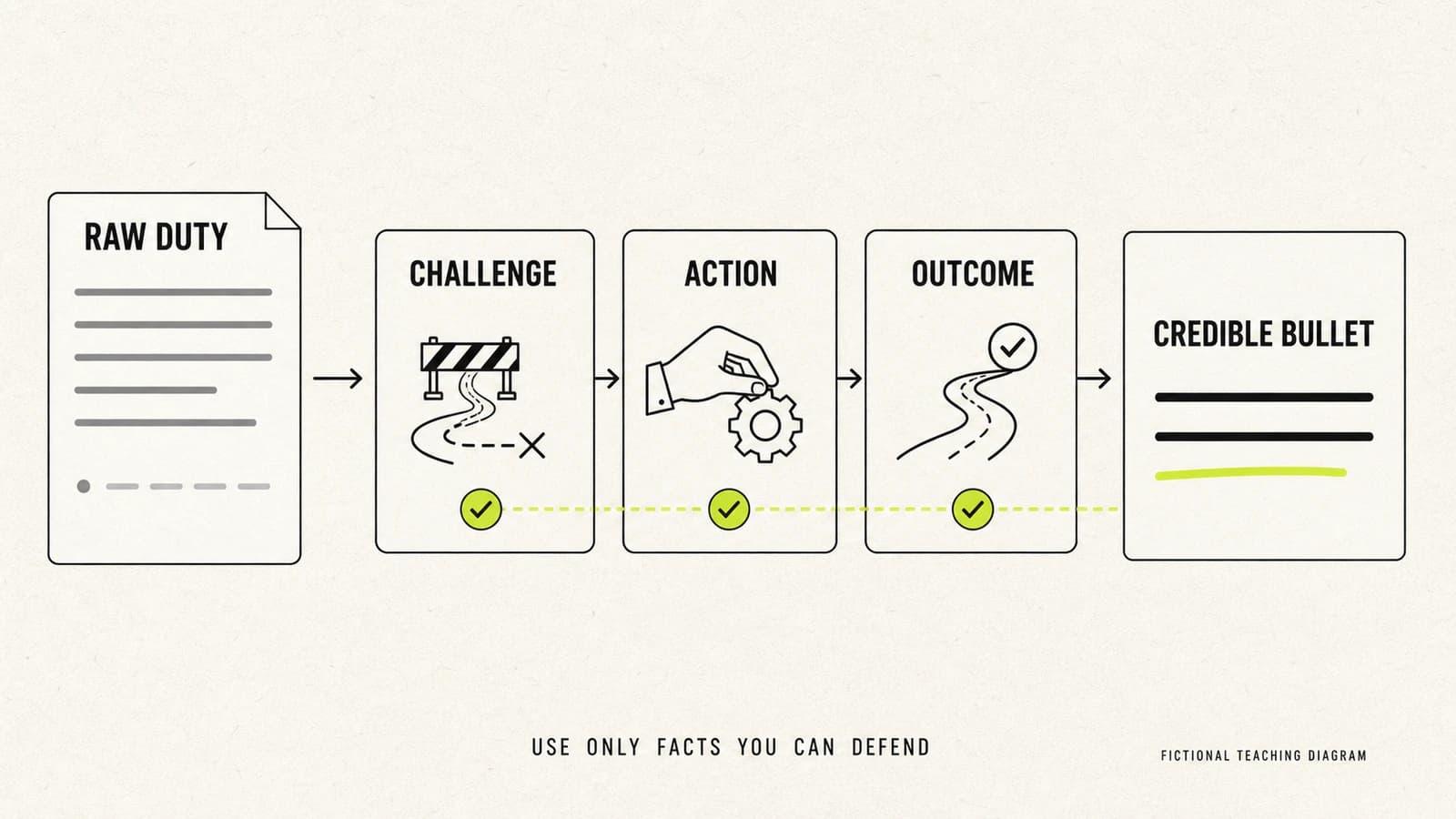
Challenge–Action–Outcome

Build the case before you compress it into one line

Career centers describe closely related STAR, PAR, CAR, and Action–Context–Result methods. The labels vary. The useful discipline is stable: recover enough context to understand the work, identify your action precisely, and state what happened next.

01

Challenge

What problem, goal, constraint, audience, or operating context made the work necessary?

Broken handoff · launch deadline · unclear owner · quality risk · growth goal

02

Action

What did you personally decide, build, analyze, change, negotiate, coordinate, or lead?

Mapped · designed · reconciled · automated · trained · negotiated

03

Outcome

What became faster, safer, clearer, more reliable, more useful, or more valuable?

Cycle time · adoption · accuracy · access · risk · revenue · continuity

Swipe horizontally to follow the CAO evidence flow

A Challenge, Action, and Outcome flow turning a raw duty into a credible resume bullet.
Fictional teaching diagram. Use Challenge, Action, and Outcome to recover evidence before writing; keep only facts you can defend. The complete method remains in the HTML above and below.

The final sentence is not a form

You might write the outcome first when it is the strongest signal, or lead with the action when the method is most relevant. “Reduced aging support cases…” and “Introduced an escalation matrix…” can both be right. The map is for thinking; the sentence is for reading.

A practical draft pattern is action + object + scope or method + outcome. Keep the challenge only when it explains difficulty, relevance, or scale that the job title cannot supply.

One fact set, three levels of wording

Turn a responsibility into evidence without changing the facts

The example below is fictional teaching material. Its people, company, workflow, and numbers are not customer data or a promised outcome.

Complete worked example

Jordan Lee

Customer Operations Specialist → Senior Customer Operations role

Fictional teaching example. Every fact and number below exists only to demonstrate the editing method.

Evidence fieldVerified source factWhat the resume may claim
Challenge146 customer cases were more than seven days old, and Product handoffs had no shared owner.Aging cases and unclear ownership created a real operating problem.
ActionJordan categorized the handoff failures, drafted an escalation matrix, and ran a weekly review.Jordan mapped, drafted, and introduced the new workflow.
ScopeThe pilot covered 18 support agents and three product teams.The team and cross-functional scope are safe to state.
OutcomeCases older than seven days fell from 146 to 61 over ten weeks.The team result may be stated with contribution language.
AttributionStaffing, product fixes, and manager escalation also affected the backlog.Jordan should not claim to have caused the entire reduction alone.

Before

Responsible for improving the customer escalation process.

After

Mapped unresolved Product handoffs and introduced an escalation matrix across 18 support agents and three product teams, helping reduce cases older than seven days from 146 to 61 in ten weeks.
Why this works: The bullet names Jordan’s action and scope, then treats the backlog reduction as a shared result. It does not claim that the matrix was the only cause.

Overclaimed

Transformed customer operations and reduced the support backlog by 58%.

Credible

Introduced an escalation matrix and weekly review for aging Product handoffs, contributing to the ten-week decline in cases older than seven days.
Why this works: The credible version gives up the dramatic verb and false precision while preserving the operating change Jordan can explain.

Specific does not always mean numeric

When you do not have a metric, replace vagueness—not honesty

Reddit discussions repeatedly surface the same fear: either invent a percentage or accept a weak bullet. That is a false choice. A number is one kind of evidence, and a naked number can still be unconvincing.

Swipe horizontally to compare nonnumeric proof signals.

Proof signalRecovery questionUseful evidenceExample pattern
ScaleHow large, broad, or complex was the work?Teams, systems, markets, accounts, locations, product lines, stakeholders, or budget responsibility.Coordinated the migration across three product teams and two time zones.
FrequencyHow often did the work happen?Daily volume, weekly cadence, monthly close, recurring launches, seasonal peaks, or on-call coverage.Produced the weekly operating review used by Finance and Sales leaders.
SpeedWhat became faster or less delayed?Cycle time, turnaround, response, handoff, release, close, or decision time.Replaced a multistep email handoff with one documented intake path.
QualityWhat became more accurate, consistent, or reliable?Fewer corrections, clearer definitions, stronger testing, stable service, or an approved source of truth.Reconciled conflicting metric definitions into one approved planning view.
RiskWhat failure, exposure, or uncertainty did you reduce?Compliance checks, release controls, escalation paths, documentation, backup ownership, or error prevention.Introduced a pre-launch privacy review that surfaced consent risks before release.
AccessWho could do or obtain something afterward?Self-service guidance, translated material, training, reusable tooling, wider availability, or a documented process.Converted a specialist report into self-service guidance for regional teams.
ClarityWhich decision, owner, or definition became explicit?Decision rights, prioritization rules, service ownership, shared terminology, or a repeatable review cadence.Established the first shared escalation path for Support and Product.

Use estimates carefully

A defensible estimate is based on a method you can reproduce: average weekly volume multiplied by the weeks you covered, a range from known account sizes, or elapsed time from project records. Round honestly and keep the relevant period visible.

Do not turn “felt faster” into “improved efficiency by 35%.” False precision creates an interview liability. If you cannot explain where the number came from and what it measures, use the strongest verified qualitative fact or leave the result open.

Impact is not the same as sole causation

Claim the part of the result that was actually yours

A team result can be valuable evidence. The mistake is not mentioning it; the mistake is writing as if no manager, teammate, market change, product release, or operating condition also contributed.
Evidence situationSafer languageCredibility test
You owned both the action and the measured resultReduced, increased, delivered, cut, grewYou can explain the baseline, period, method, and why your work caused the change.
You owned the action; the team owned the resultHelped reduce, contributed to, supportedYour contribution is specific, while the broader result is explicitly shared.
Your work created a condition for a later outcomeEnabled, established, unlocked, made possibleYou can name the artifact or capability that others used afterward.
The business result happened nearby, but causation is unclearState the action and scope; omit the causal claimYou cannot isolate your contribution from market, pricing, staffing, or other changes.
You remember improvement but cannot verify the numberUse a qualitative before-and-after or recover the sourceA report, dashboard, document, calculation, or credible stakeholder could confirm it.

Match the verb to your authority

“Supported,” “coordinated,” “owned,” “led,” and “set direction” are not interchangeable action verbs. Choose the strongest one you can defend, not the strongest one on an action-verb list. This matters most in collaborative projects: precise ownership is more credible than inflated leadership language.

Apply the same method to different work

Four transformations show what the formula is really doing

These are fictional teaching examples, not customer resumes. They are deliberately limited to four transformations; use the achievement library when you need more role and evidence patterns.

Software engineering duty

Worked on improving authentication.

Evidence-led bullet

Reworked token refresh and failure handling across three web applications, removing a recurring sign-in loop documented in release support tickets.
Why this works: The bullet names the technical action, product scope, and observable quality change without inventing latency, traffic, or conversion data.

Marketing participation

Helped with the product launch campaign.

Evidence-led bullet

Built the launch email sequence for two customer segments using interview themes supplied by Product Marketing, contributing to the cross-channel release campaign.
Why this works: The rewrite identifies the deliverable and audience while keeping the campaign result shared. Add an engagement or pipeline result only if the attribution is supportable.

Administrative responsibility

Responsible for scheduling meetings and preparing documents.

Evidence-led bullet

Coordinated weekly decision meetings for six department leads and maintained the action log, giving owners and deadlines one shared record.
Why this works: Scale, audience, and the durable operating change make routine coordination understandable without a revenue number.

Student research task

Collected and analyzed research data.

Evidence-led bullet

Cleaned survey responses and analyzed group differences in R for a faculty study, then translated the findings into a poster for a campus research symposium.
Why this works: Specific methods, audience, and deliverable demonstrate capability even when the student did not own the study’s final outcome.

A repeatable writing workflow

Write the bullet in six passes instead of polishing one vague line

Most weak bullets are not a vocabulary problem. They are a missing-evidence problem. Each pass below produces one concrete input for the next.
  1. 01

    Choose the capability the target job needs

    Use one real job description. Pick a responsibility, skill, or outcome that matters and that your experience can genuinely support.

    Output: One target capability

  2. 02

    Write the unpolished duty

    Describe the work in plain language. Do not chase verbs yet. A rough line such as “handled escalations” is enough to identify the starting point.

    Output: One raw responsibility

  3. 03

    Recover Challenge, Action, and Outcome

    Ask what was happening, what you personally did, and what changed. Add scope, method, constraint, and attribution while the facts are still separate.

    Output: A small fact ledger

  4. 04

    Choose one primary proof signal

    Lead with the evidence most relevant to the target: result, scale, quality, speed, risk, access, clarity, or ownership. Do not force all of them into one sentence.

    Output: One reason the bullet matters

  5. 05

    Draft with the right ownership verb

    Combine action, object, scope or method, and outcome. Use direct or contribution language according to what you can actually claim.

    Output: One evidence-led draft

  6. 06

    Verify, trim, and order

    Confirm each fact, remove setup the role already explains, and place the most target-relevant bullet first. Save the full evidence note for future versions and interviews.

    Output: A defensible submitted bullet

Keep the underlying facts outside the submitted resume

Save a private evidence note with the full challenge, your decisions, collaborators, metric source, calculation, dates, and artifact. The resume needs the compressed line; an interview may need the complete story.

That private record also makes future tailoring faster. Use the master-resume and version system to change emphasis for a role without rewriting the underlying history or losing the original evidence.

Edit for credibility and scan speed

Run these six checks before you keep a bullet

A bullet is finished when it is relevant, specific, readable, and defensible—not when it contains the maximum number of action verbs and metrics.
Draft patternWhy it failsEditing move
Responsible for / duties includedThe sentence describes the job, not your contribution.Start with the decision, deliverable, analysis, change, or service you provided.
Successfully / effectively / significantlyThe adjective asks the reader to accept your conclusion.Replace it with observable scope, method, change, or an attributable result.
Improved efficiency by 35%The metric has no baseline, unit, method, or action.Name what changed, how the percentage was calculated, and what you did.
Collaborated with cross-functional stakeholdersThe phrase hides the purpose, functions, and decision.Name the teams, the disagreement or goal, your action, and what became possible.
Used Excel, SQL, Tableau, and PythonA tool inventory does not show capability or outcome.Show which problem you solved with the relevant tools and who used the result.
One bullet containing an entire project historyToo many clauses bury the strongest evidence.Keep one primary contribution per bullet; use a second bullet for distinct proof.

Keep the bullet when

  • It supports a real capability the target job values
  • The action is specific and the ownership level is accurate
  • The scope or outcome makes the work easier to understand
  • Every number has a source or reproducible calculation
  • You can explain the full story in an interview

Leave it out or recover more evidence when

  • It repeats a generic duty already implied by the title
  • The metric exists only because a template suggested one
  • The result belonged to the business but your contribution is unclear
  • The sentence depends on an exaggerated title or authority level
  • A more relevant achievement needs the space

After the individual bullets are credible, run the 10-second resume test. The strongest relevant contribution should be easy to find near the top of each important role—not buried beneath routine work.

Resume bullet point FAQ

Questions that come up when the facts are incomplete

What is the best formula for a resume bullet point?

A useful formula is Challenge, Action, Outcome: identify the problem, goal, constraint, or scope; state what you personally did; then show the verified result or meaningful change. The final sentence does not need to follow that order mechanically.

Do all resume bullet points need numbers?

No. Use a number when it is accurate and helps explain scale or change. Without a defensible metric, use specific evidence such as team or system scope, frequency, complexity, risk reduced, access expanded, ownership clarified, or a durable process introduced.

Can I estimate a metric for my resume?

Use an estimate only when you can explain the method, label the scope honestly, and defend it in an interview. Do not invent a precise percentage because it sounds plausible. A truthful range or a nonnumeric fact is stronger than false precision.

How do I write a bullet when the result belonged to a team?

Separate your action from the team outcome. Name what you designed, analyzed, coordinated, built, or owned, then use contribution language such as helped, supported, contributed to, or enabled when you cannot claim sole causation.

Should I start every bullet with an action verb?

Usually, yes. A precise action verb makes your contribution easier to find. The verb must also match your authority: supported, coordinated, designed, led, and set direction describe different levels of ownership.

How long should a resume bullet point be?

Use the shortest sentence that preserves the action and the evidence needed to understand it. One or two rendered lines is a practical editing target, not a universal rule. Remove setup that the job title already supplies before removing useful proof.

Editorial method

We reviewed current university career-center guidance on action, context, results, STAR/PAR/CAR thinking, accurate quantification, and accomplishment statements. We also reviewed recent and long-running r/resumes discussions about responsibility-only bullets, inaccessible metrics, suspicious percentages, team attribution, and the limits of “quantify everything.” Reddit material is qualitative evidence of recurring job-seeker questions and individual opinions—not proof that one formula, number, or phrase changes hiring outcomes.

Sources reviewed

Turn your recovered facts into one editable bullet

The Resume Bullet Generator can organize the action, scope, and outcome you provide. It will not invent a metric, verify a claim, or decide that a team result belongs to you.

Build a resume bullet