Career change · 15 minute practical guide

Your Job Title Doesn’t Match the Role You Want—What Should Your Resume Say?

Keep the official title, add a truthful functional clarifier when needed, and prove the target work in your summary and bullets without rewriting employment history.

My Best Resume Editorial TeamReviewed by Jenny Zhuang · FounderReviewed August 3, 2026Published Updated

The answer first

Keep the official title; add truthful context beside it.

When your job title does not match the role you want, do not rewrite employment history. Use the official title and, if it is genuinely unclear, add a narrow functional clarifier such as Operations Coordinator (Analytics & Reporting). Then make the target work visible through your summary, skills, projects, and evidence-led bullets.

  • Employer-record title stays in work history
  • A parenthetical clarifier must describe documented work
  • The target title belongs in the headline or summary
  • Bullets—not title substitution—prove the functional match

History, context, and direction are different fields

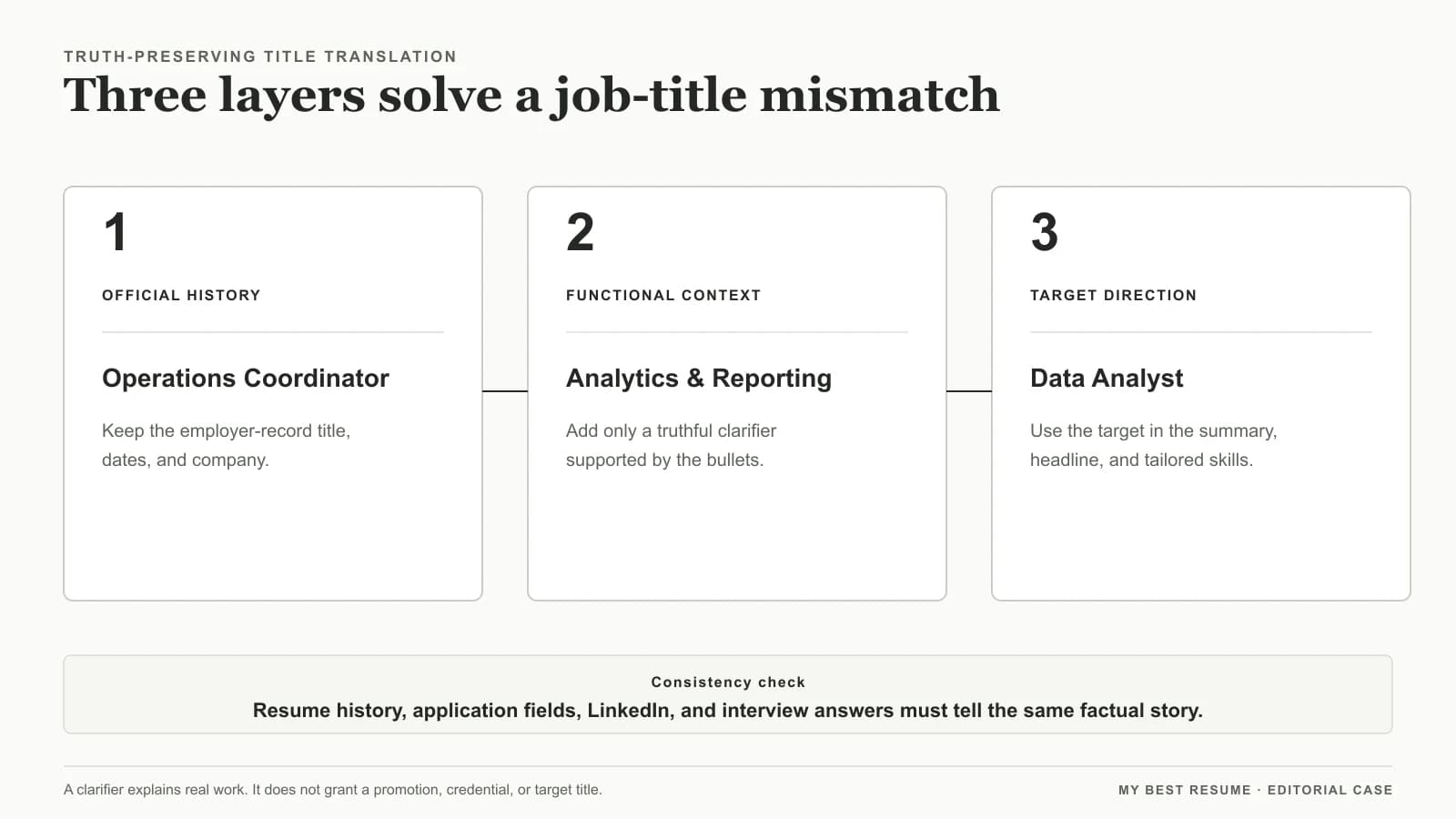
Use three layers instead of one inflated title

A resume has room to explain both where you were and where you are going. The mistake is forcing the target title into an employment-history field that can be checked against employer records.

Swipe horizontally to compare official title, clarifier, and target direction

Three-layer title framework separating official history, functional context, and target direction.
Original teaching diagram. A functional clarifier explains supported work; it does not grant a promotion, credential, regulated role, or target title.
LayerWhere it appearsWhat it may sayWhat it must not do
Official historyExperience heading and application employment fieldsOperations CoordinatorReplace the employer-record title with Data Analyst
Functional contextParentheses or a short descriptor beside a vague official titleAnalytics & ReportingImply an unsupported promotion, license, or specialty
Target directionHeadline, summary, selected skills, project label, cover letterData Analyst targetPresent aspiration as completed employment
ProofBullets, projects, portfolio, and interview examplesSQL reporting, source validation, dashboard QA, decision supportUse a keyword without evidence

Concrete case · Riley Morgan

An Operations Coordinator can show data-analysis work without becoming a fictional Data Analyst

Riley's case is a new composite created from the internal Data Analyst knowledge base's public-safe structure, title-routing logic, evidence metrics, and resume rules. The private source samples remain internal: no name, experience, wording, number, or original document has been copied.

Swipe horizontally to inspect Riley's title line and resume evidence

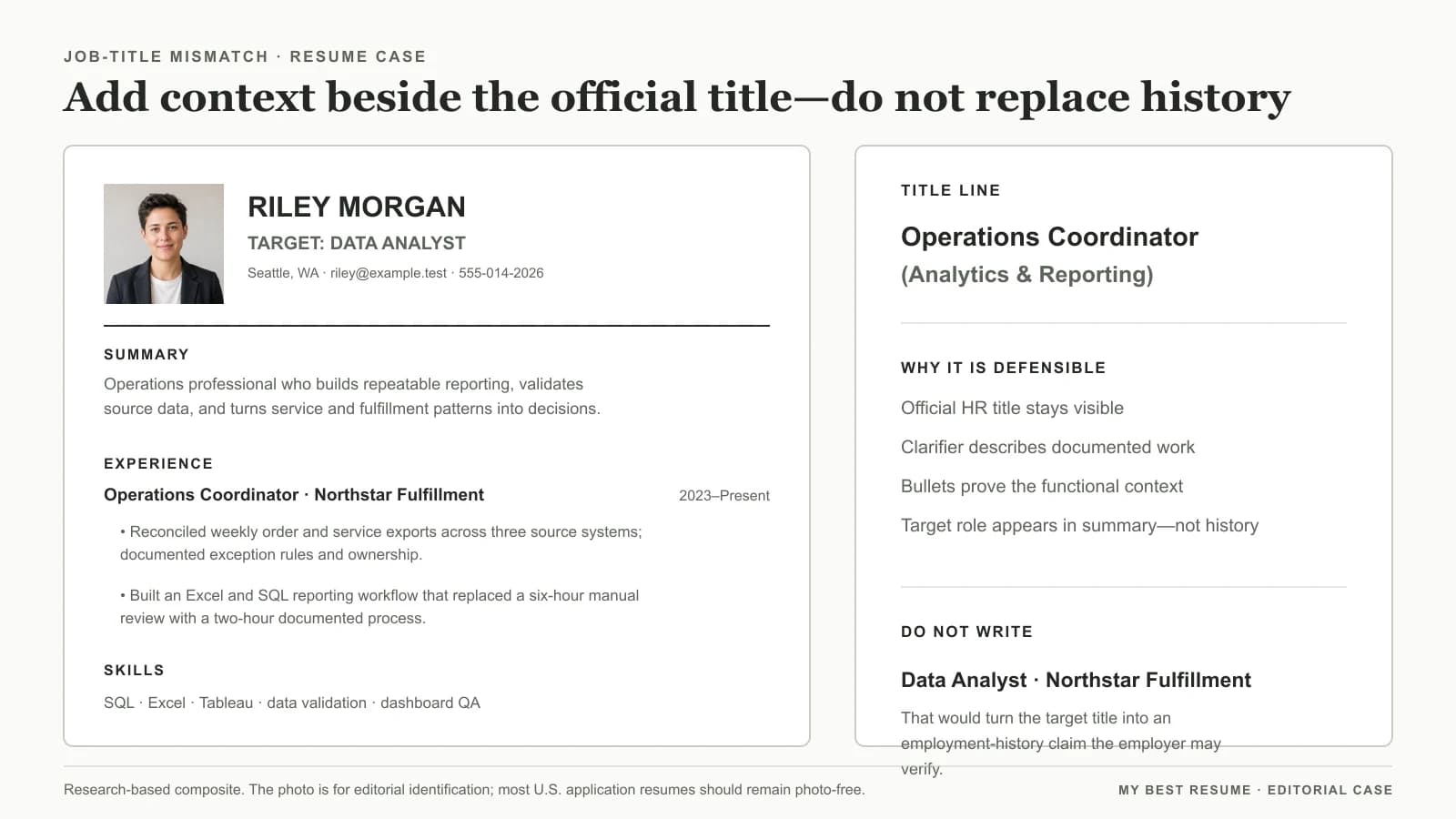
A fictional Riley Morgan resume using Operations Coordinator with an Analytics and Reporting clarifier instead of changing the title to Data Analyst.
Research-based composite with an AI-generated fictional person. The photo identifies the editorial case only; most U.S. application resumes should be submitted without a photo. All employers, contact details, work facts, and figures are invented.

Misleading history

Data Analyst · Northstar Fulfillment · 2023–Present

Truthful title context

Operations Coordinator (Analytics & Reporting) · Northstar Fulfillment · 2023–Present
Why this works: The official title remains visible. The clarifier is narrower than the target role and must be supported by the experience bullets.

Keyword without proof

Performed data analysis and built dashboards.

Target work with proof

Reconciled weekly order and service exports across three fictional source systems; documented exception rules and ownership for operations and support leads.
Why this works: The rewrite names the data, cadence, scope, control, and audience. It does not claim a tool or business result that Riley cannot support.

A clarifier is an explanation, not a promotion

Use parentheses only when they reduce real ambiguity

Reasonable

Business Associate (Revenue Operations) when the documented work centered on CRM reporting, pipeline hygiene, forecasting support, and sales-process analysis.

The descriptor names the function; it does not claim a manager or analyst title.

Reasonable

Project Coordinator (Clinical Operations) when the work supported study documentation, schedules, sites, and regulated operating processes.

Use only when the clinical context is accurate and no license is implied.

Needs caution

Software Engineer for an official IT Specialist title.

Use IT Specialist (Application Development) if that accurately describes the work; do not upgrade the employer title merely because the target role uses a different family.

Do not use

Director, Registered Nurse, CPA, Attorney, Security-Cleared Engineer, or another level, license, or status the person did not hold.

A parenthetical cannot cure an unsupported credential or authority claim.

Make the target role discoverable without rewriting history

Distribute target language across evidence-bearing sections

  1. 01

    Write a target headline

    Use a direction, not a false appointment: Operations professional transitioning to data analysis, or Data analytics | SQL · Excel · reporting operations.

    Check: The wording does not imply years in a title Riley never held.

  2. 02

    Build a fact-led summary

    Lead with relevant scope, methods, tools, stakeholders, and outcomes. Remove adjectives that cannot be tested.

    Check: Every summary claim points to experience, project, or education evidence below.

  3. 03

    Reorder existing bullets

    Put reporting, validation, analysis, dashboard, investigation, and decision-support evidence before less relevant coordination duties.

    Check: Chronology, title, employer, dates, and ownership remain unchanged.

  4. 04

    Add projects only when real

    Use a project for analysis work completed outside the formal job, with source, question, method, output, and limitation.

    Check: A tutorial is not presented as employer work or production impact.

  5. 05

    Leave hard gaps visible

    If the target requires a tool, license, degree, authorization, or experience Riley lacks, do not hide the gap with a title change.

    Check: The application and interview tell the same story.

For broader role translation, use the career-change resume guide. For one actual posting, compare Riley's evidence with the job in the Resume–Job Matcher.

Before submission and background review

Make every surface tell the same factual story

SurfaceUseConsistency ruleArchive
ResumeOfficial title plus optional truthful clarifierDates and employer match the applicationExact submitted file
Application formUse the employer-record title when the field asks for titleDo not paste the target title into employment historySubmitted answers and confirmation
LinkedInOfficial title; description can surface functional workAvoid a different promotion storyProfile snapshot or change log
Cover letterExplain why the evidence transfers to the target roleDo not apologize or invent a past titleExact sent letter
InterviewDescribe official role, actual work, contribution, and target directionAnswer direct verification questions truthfullyEvidence notes, not a memorized fiction

Job-title mismatch FAQ

Keep the story accurate and findable

Can I change my job title on my resume to match the job I want?

Do not replace the employer-record title with the target title. Keep the official title, then add a truthful functional clarifier in parentheses when the official label is unusually vague and your documented work supports the clarification.

What if my official title was generic, like Associate or Coordinator?

Use the official title plus a narrow descriptor such as Operations Coordinator (Analytics & Reporting). The bullets must prove the descriptor. Avoid a clarifier that implies a promotion, license, regulated role, or specialty you did not hold.

Will a background check verify my job title?

Employment-history checks can include prior employment information, and practices vary. Keep resumes, application fields, LinkedIn, and interview answers consistent. If a third-party report is used in the U.S., federal law provides notice and dispute rights; this guide is not legal advice.

Where should the target job title appear?

Use it in a truthful target headline or summary, for example Data Analyst target or Operations professional transitioning to data analysis. Do not place it in past employment history as though the employer awarded that title.

How do I get past ATS title matching without lying?

Use the target role language in the headline, summary, skills, and accomplishment bullets where it accurately describes real work. A keyword is strongest when the surrounding sentence proves the relevant problem, method, scope, and result.

Editorial method

CareerOneStop supports translating obscure titles into understandable functional language in a defined military-to-civilian context and recommends combination resumes for transferable skills. CFPB and EEOC establish that employment history can appear in background processes and describe U.S. report rights. Reddit supplies the recurring mismatch question only; it does not authorize title substitution.

Sources reviewed

Translate the work—not the employment record

Use a target job description to find which parts of your real experience are direct, adjacent, missing, or deprioritized before rewriting titles or bullets.

Map my evidence to the role