Reliability
A failure mode stopped recurring, recovery became safer, alerts became actionable, or ownership became explicit.
Resume strategy · 15 minute practical guide
Reconstruct the system problem, engineering decision, production scope, and verified change; a defensible qualitative outcome is stronger than false precision.
The answer first
To show software engineering impact without inventing metrics, reconstruct the before-and-after from technical records. Explain the system or workflow, the decision you made, where it operated, and what became safer, faster, clearer, more reliable, or newly possible. Add a number only when you can defend its definition and source.

Impact is broader than revenue and percentages
A failure mode stopped recurring, recovery became safer, alerts became actionable, or ownership became explicit.
A path became faster or more efficient, even when the exact production change is unavailable.
A deployment, migration, review, or release process became repeatable and less fragile.
Tests, contracts, validation, or review controls made defects easier to prevent or locate.
Documentation, tooling, APIs, or paved paths made work more self-service and consistent.
A capability became available, a blocked workflow worked, or support pain was removed.
“Improved performance” is still vague. “Removed repeated database reads from the account-search path and added a cache invalidation test” is specific even before a latency number appears. The exact system, decision, and verified change carry the evidence.
Problem → decision → scope → change
Swipe horizontally to follow the technical impact evidence map
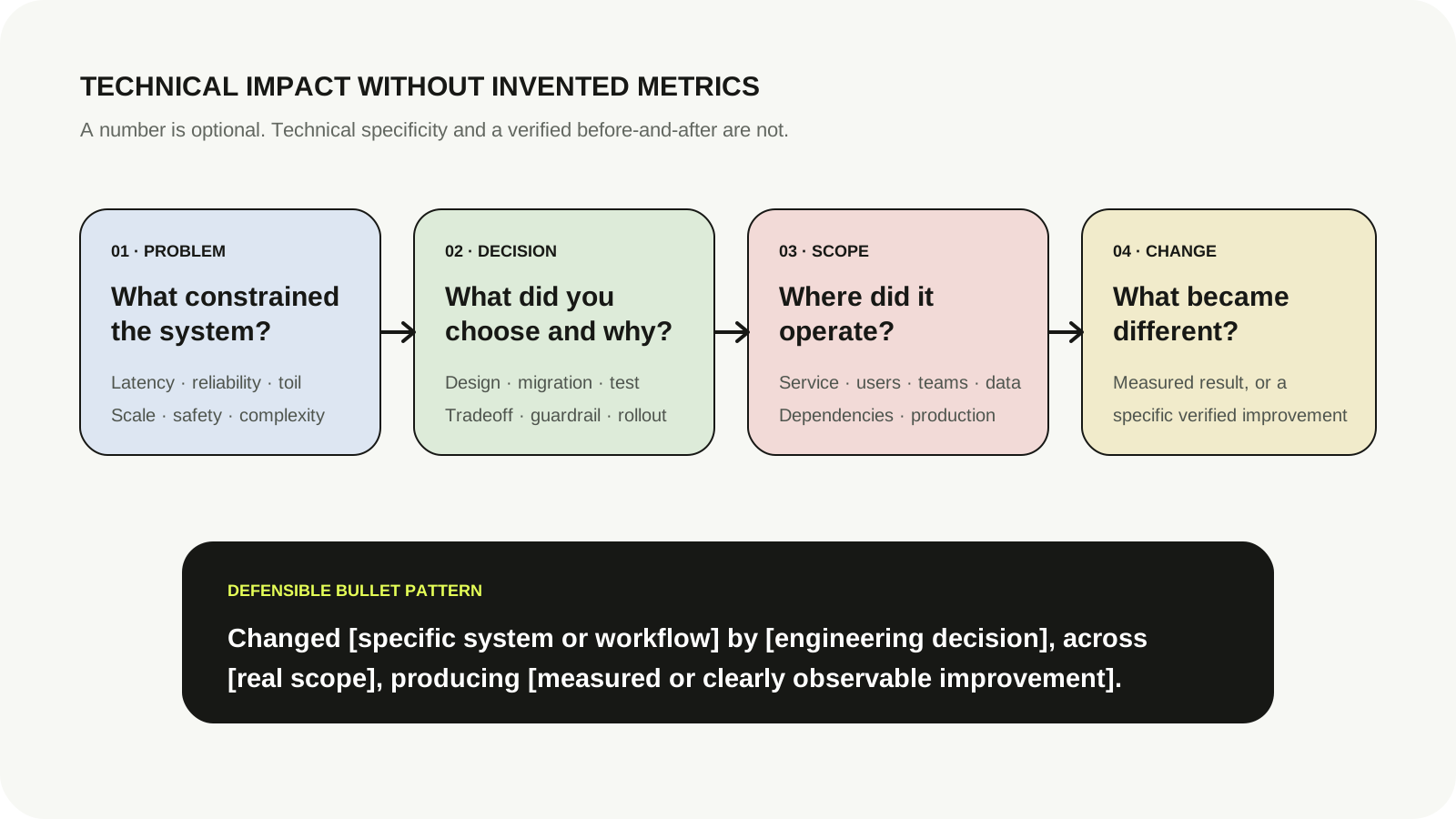
| Evidence block | Recovery question | Possible source |
|---|---|---|
| Problem | What failure, constraint, toil, risk, or user need made the work necessary? | Incident review · issue · support pattern · design context |
| Decision | What did you personally design, change, test, migrate, automate, or sequence—and why? | Design doc · pull request · architecture review · rollout plan |
| Scope | Which service, users, data, teams, dependencies, or production boundary did it affect? | Service catalog · runbook · ticket set · release record |
| Change | What became observably different, and who can verify it? | Dashboard · test report · postmortem · deployment record · stakeholder |
One fictional engineering history
Complete worked example
Software Engineer → Senior Backend Engineer
Fictional worked example based on common hiring scenarios. Every fact and number is illustrative.
Before
After
Before
After
Before
After
Before
After
For complete summaries, skills, seniority examples, templates, and a role-prefilled builder, use the Software Engineer resume workspace. This article owns only the no-false-metrics evidence problem.
Use numbers only when they clarify the work
| Check | Question | If the answer is no |
|---|---|---|
| Definition | Do I know exactly what this metric measures? | Use the system or process change without the number. |
| Baseline | Is the before value comparable to the after value? | Describe the verified direction of change, not a percentage. |
| Scope | Which endpoint, service, workload, environment, or user group is included? | Narrow the claim to the boundary you can support. |
| Period | When and for how long was the result observed? | Avoid language that implies a permanent outcome. |
| Attribution | Can I explain why my work contributed to the change? | State your action and label the broader result as shared. |
| Source | Can a report, artifact, calculation, or credible person confirm it? | Recover the source or omit the number. |
A six-pass evidence workflow
Use one job description and choose a system, practice, or responsibility your real work supports.
Describe the work without résumé language: maintained checkout services, migrated endpoints, improved deploys.
Use records to identify the constraint and the engineering choice that was actually yours.
Name only the service, users, workload, teams, dependencies, or environment you can verify and safely disclose.
Use the strongest supported before-and-after; never add a percentage merely because the sentence feels incomplete.
Match the verb to your authority, preserve team contribution, trim stack noise, and keep the full source note for interviews.
Software engineer impact FAQ
No. Use a number when it is accurate, relevant, and based on a definition you can explain. A specific system, engineering decision, production scope, and observable change can show impact without a percentage.
Use engineering evidence such as a failure mode removed, safer rollout, clearer ownership, reduced operational toil, successful migration, improved test coverage, broader self-service access, or a documented before-and-after. State only what the records support.
Estimate only when you can reproduce the method, label the scope honestly, and defend the range. Do not convert a subjective impression into a precise percentage. A verified qualitative statement is stronger than false precision.
Separate your decision or deliverable from the shared result. Name what you designed, implemented, analyzed, coordinated, or led, then use contribution language when you cannot claim sole causation.
Include technologies that help explain the decision, architecture, or target fit. A stack list without the system problem, scope, or change is not an achievement. Keep the complete inventory in a concise skills section.
Editorial method
We used official U.S. occupation references to confirm the role boundary: analyzing needs, designing and developing software, maintaining systems, testing, documenting, and collaborating. We also used public university career guidance for accomplishment wording. This article does not publish job-description frequency percentages because the current JD dataset has not passed the project's publication manifest gate.
Sources reviewed
Official occupation reference for software-development tasks, work activities, technologies, and related titles.
Official description of software development, testing, maintenance, collaboration, and work context.
University career guidance on pairing action with quantitative or qualitative context and an end result.
Use the role workspace for summaries, skills, bullet comparisons, templates, and a prefilled target. Keep every system, metric, and outcome tied to a source you can explain.