U.S. job search · 13 minute practical guide
How to Write a U.S. Resume When All Your Experience Is Outside America
Translate overseas experience for U.S. employers without changing titles, inflating credentials, hiding locations, or stripping away useful context.
The answer first
Translate the context, not the truth.
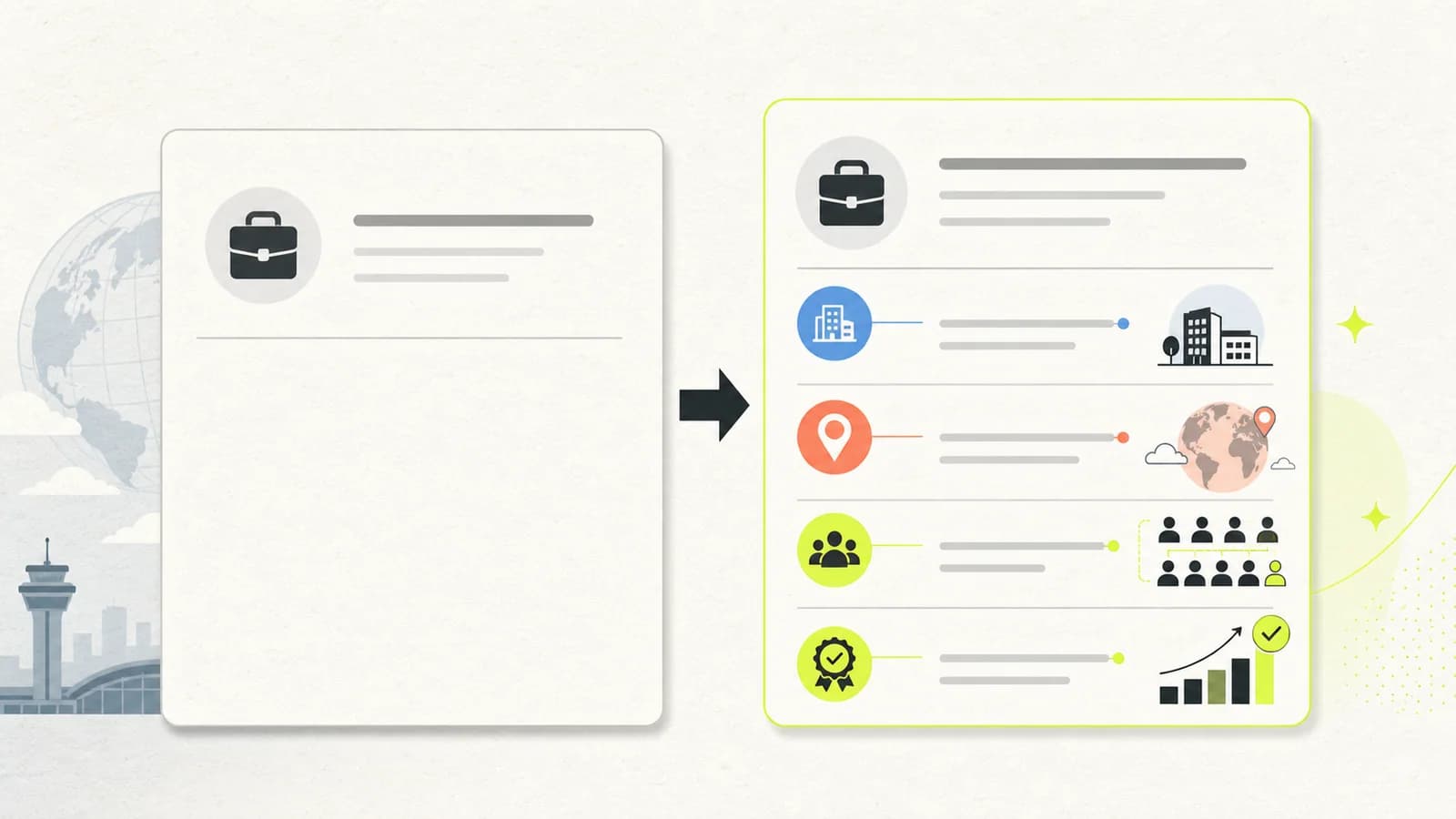
Keep real employer names, titles, dates, locations, credentials, and results. Then add the context a U.S. reader may lack: what the organization does, the scale of your responsibility, an accurate English title translation, and outcomes in plain American English. Do not claim a U.S. credential equivalency unless an appropriate authority has established it.
- Preserve original facts
- Explain unfamiliar context
- Show scope and outcomes
- Use a simple 1–2 page layout

Core principle
A U.S. resume needs a frame of reference, not a rewritten identity
Use these checks as a research framework. Individual immigration, employment, and tax conclusions require advice for the actual person, employer, role, and country.
Use reverse chronological order, familiar section headings, consistent dates, and a readable single-column structure. One or two pages is a useful range for many private-sector applications, but seniority, field, and employer instructions should determine the final length.
Avoid translating “foreign experience” into generic duties. Your advantage is often the scale, complexity, customer environment, languages, regulations, or cross-border coordination you handled. Explain those facts in terms relevant to the target job.
Swipe horizontally to compare the details.
| Resume fact | Keep | Add only when useful |
|---|---|---|
| Employer | Official organization name | One-line descriptor: industry, customers, size, or market position you can verify. |
| Title | Official title or a faithful English translation | Original-language title in parentheses, or a functional clarification—not a promotion. |
| Location | City and country | Remote or multi-country scope if it affected the work. |
| Results | Verified numbers, dates, and units | A reader-friendly scale comparison; retain original currency or explain any conversion and date. |
| Education | Actual degree and institution | English translation, field, honors, or evaluator result when requested and verified. |
Experience section
Write bullets around decisions, scope, and outcomes
Start with your verified notes: customer type, team size, budget, transaction volume, geography, systems, constraints, actions, and outcomes. Select the details that match the target role. If you do not know a metric, describe the observable change without inventing one.
Use terms familiar in the target occupation when they are genuinely equivalent. For example, “managed vendor onboarding” may be clearer than a company-specific process name. Preserve local terms when the difference matters, and explain them briefly.
Education and credentials
Translate carefully and let the right authority decide equivalency
Use these checks as a research framework. Individual immigration, employment, and tax conclusions require advice for the actual person, employer, role, and country.
- List the real institution, city/country, degree name, field, and completion date.
- Add a faithful English translation when the credential name would otherwise be unclear.
- Do not write “U.S. bachelor’s equivalent” because it sounds plausible. Include equivalency only if a relevant evaluator or authority has established it and the application needs it.
- For regulated professions, check the state licensing board or other competent authority; a resume cannot solve a licensing requirement.
- Do not convert grades mechanically across systems unless the recipient asks for a specified method.
U.S. conventions
Remove personal details that do not help evaluate the job
Use these checks as a research framework. Individual immigration, employment, and tax conclusions require advice for the actual person, employer, role, and country.
- Usually omit a photo, date of birth, marital status, religion, national ID numbers, passport details, and immigration documents.
- Use a U.S. phone number only if it is genuinely yours; otherwise provide a reliable international number with country code.
- State your real location. If relevant, add “Open to relocation” or a specific relocation plan rather than presenting a false U.S. address.
- Use a professional email and a LinkedIn or portfolio URL only when current and useful.
- Export to PDF unless the employer requests another format; verify text extraction and links before submitting.
Worked rewrite
Give an unfamiliar employer just enough context to matter
Use these checks as a research framework. Individual immigration, employment, and tax conclusions require advice for the actual person, employer, role, and country.
A bare entry—company, title, dates—forces the reader to guess whether Maruva is a two-person shop, a government agency, or a national retailer. A compact descriptor can establish the frame: “Member-owned consumer retailer operating 28 stores across Kenya.” That statement belongs only if the candidate can verify it and if the scale helps the target employer understand the work.
A faithful bullet might read: “Coordinated weekly inventory planning across 12 stores and three distribution partners, introducing a shared exception log that cut unresolved stock discrepancies from the verified baseline to the documented later result.” If the candidate does not have reliable before-and-after numbers, the sentence should name the process change and observed outcome without creating a percentage.
If the official title has no clear U.S. counterpart, retain it and add a functional clarification such as “Regional Coordination Lead (multi-site retail operations).” Do not replace it with “Director” simply because that title may attract more searches. Background checks and interviews should encounter the same career history.
- Use the summary to state target direction, not to apologize for international experience.
- Use a cover letter for relocation timing, motivation, or a complex transition that does not belong in every resume bullet.
- Align LinkedIn and application forms with the same employers, titles, dates, and locations; format may differ, facts should not.
Final review
Test the resume with someone who lacks your context
Ask the reviewer to name your likely role, level, industry, strongest evidence, and any confusing employer or credential within a short read. Clarify only the points they could not infer. Too much explanation can bury the work just as easily as too little.
Then compare the resume with the specific job description. Tailoring means changing emphasis and wording around verified experience—not adopting responsibilities you never had.
Common questions
Short answers before you act
- Should I translate my foreign job title?
- Use a faithful English translation when it helps the reader. Preserve the official title or original-language version when useful, and add a functional clarification rather than choosing a more senior U.S. title. The application, interview, and background check should encounter the same underlying role.
- Should I convert foreign salary or revenue into U.S. dollars?
- Only when the comparison is relevant and you can document the original amount, conversion method, and date. Often the original currency plus operational scale is clearer. Do not convert a number in a way that hides inflation, exchange-rate timing, or what portion you actually influenced.
- Should a U.S. resume include a photo or personal details?
- For most U.S. private-sector applications, omit a photo, birth date, marital status, religion, national identity numbers, passport details, and similar personal information. Follow a specific employer or occupation requirement when one legitimately applies, and keep the resume focused on job evidence.
- Should I put my visa status on the resume?
- Usually answer work-authorization and sponsorship questions in the employer’s application or recruiter process rather than turning status into a resume headline. State your real location and relocation intent. If an employer explicitly requests authorization information in the resume, answer accurately and minimally.
Continue the research
Related U.S. job-search guides
- Run the 10-second resume test
Check whether a new reader can find the role and evidence.
- Tailor without rewriting from zero
Build reusable role-family versions.
- Choose a realistic U.S. job route
Align the resume with an achievable path.
Editorial method
Reviewed July 28, 2026. We prioritized current U.S. government and university career-center material, separated historical data from present employer policy, and avoided predicting individual immigration outcomes. This educational guide is not legal, tax, or employment advice.
Sources reviewed
- CareerOneStop resume formatting
U.S. Department of Labor-sponsored guidance on readable resume format.
- CareerOneStop work experience
Guidance on relevant duties, accomplishments, and context.
- U.S. Department of Education
Who recognizes foreign qualifications for work, study, and licensing.
- University of Maryland international resume guide
Career-center guidance on framing overseas education and experience.
Turn overseas experience into target-role evidence.
Analyze the facts already in your resume, identify what needs context, and keep every rewritten claim grounded in your real work.