ATS · 14 minute practical guide

What Is a Good ATS Score? Why 80% Is Not a Universal Resume Target

Treat an ATS score as one checker's editing signal, not an employer pass mark; verify extraction, hard requirements, visible evidence, and honest gaps instead.

My Best Resume Editorial TeamReviewed by Jenny Zhuang · FounderReviewed August 3, 2026Published Updated

The answer first

There is no universal good ATS score—not even 80%.

Treat an ATS score as a diagnostic inside one tool, not as an employer pass mark. A useful resume review asks whether the file can be read, whether stated hard requirements are supported, whether the strongest evidence is easy to find, and which gaps still require a question. None of those checks can promise an interview.

  • Identify who created the score and its rubric
  • Separate parsing from qualification and hiring decisions
  • Fix truthful evidence gaps before cosmetic point changes
  • Stop when higher points would make the resume less honest

The label hides several different systems

Ask what the number measures before trying to improve it

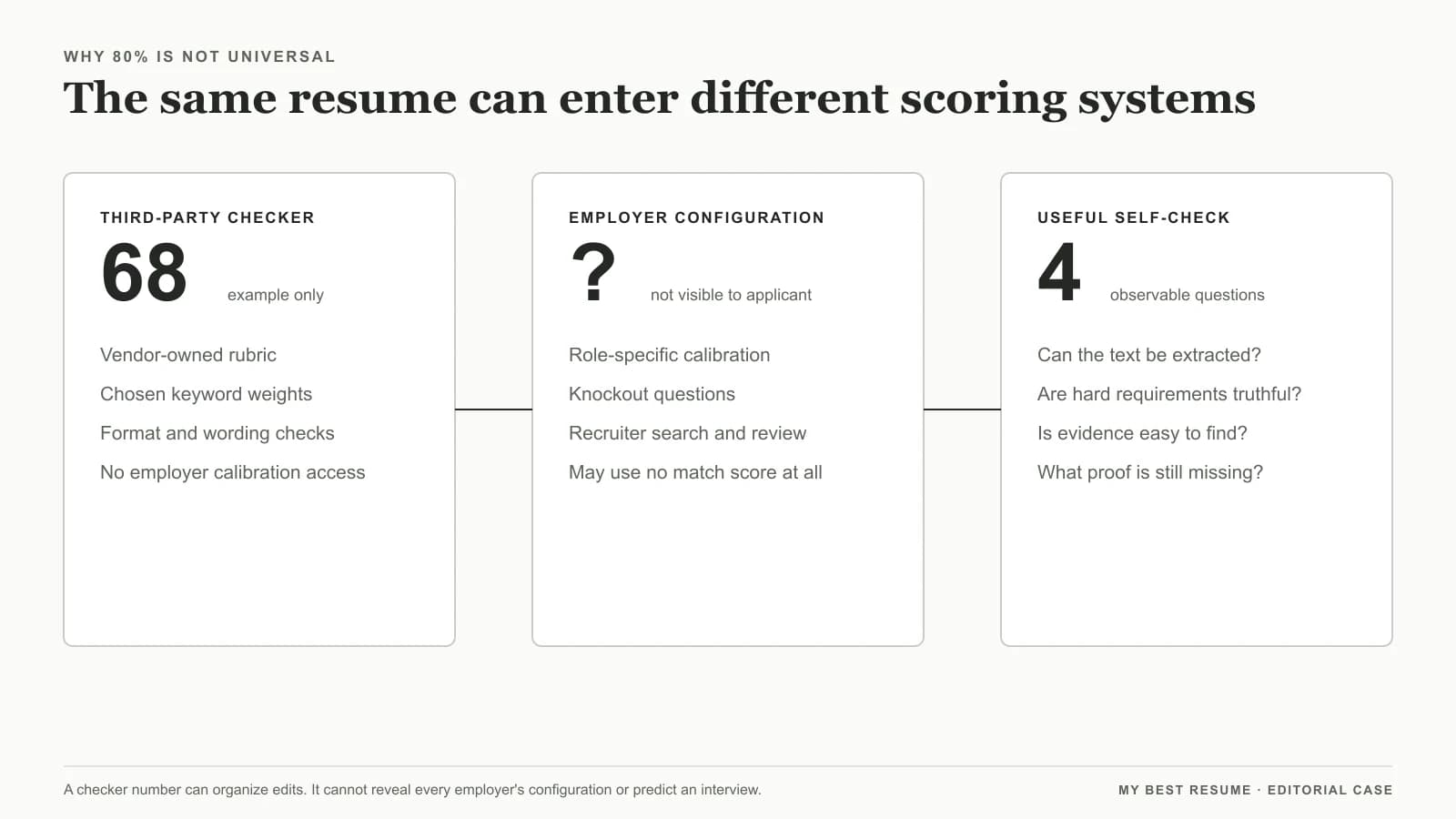
Reddit questions often treat every number labeled ATS as the same thing. Current product documentation shows a more complicated reality: parsing, employer calibration, screening, and structured interview evaluation are different operations.

Swipe horizontally to compare the three scoring contexts

A third-party checker, employer configuration, and observable self-check shown as three different resume evaluation systems.
Original editorial diagram. The 68 is explicitly illustrative, not a customer result or employer cutoff; the useful questions are repeated in HTML below.
SystemWhat it can measureUseful interpretationBoundary
Third-party resume checkerIts own keyword, content, format, or similarity rubricHelpful for finding issues inside that rubricIt cannot reveal every employer's setup or predict an interview
Employer resume parserExtracted name, contact information, work history, and other fieldsShows whether the file became usable candidate dataSuccessful extraction does not establish qualification or selection
Employer-calibrated match featureResume evidence against criteria and weights chosen for that roleCan prioritize review when the employer enables and governs itThe calibration is role-specific and may be unavailable to applicants
Interview scorecardEvidence collected later against structured interview attributesSupports consistent team evaluationIt is not a resume-upload score and occurs at another stage

Greenhouse now documents an employer-side Talent Matching feature in which recruiters define and weight a calibration. That is proof that a match score can exist—not proof that one public 80% target applies to every employer, role, ATS, or checker.

Concrete case · one research-based composite

Riley’s resume is useful because its evidence is inspectable

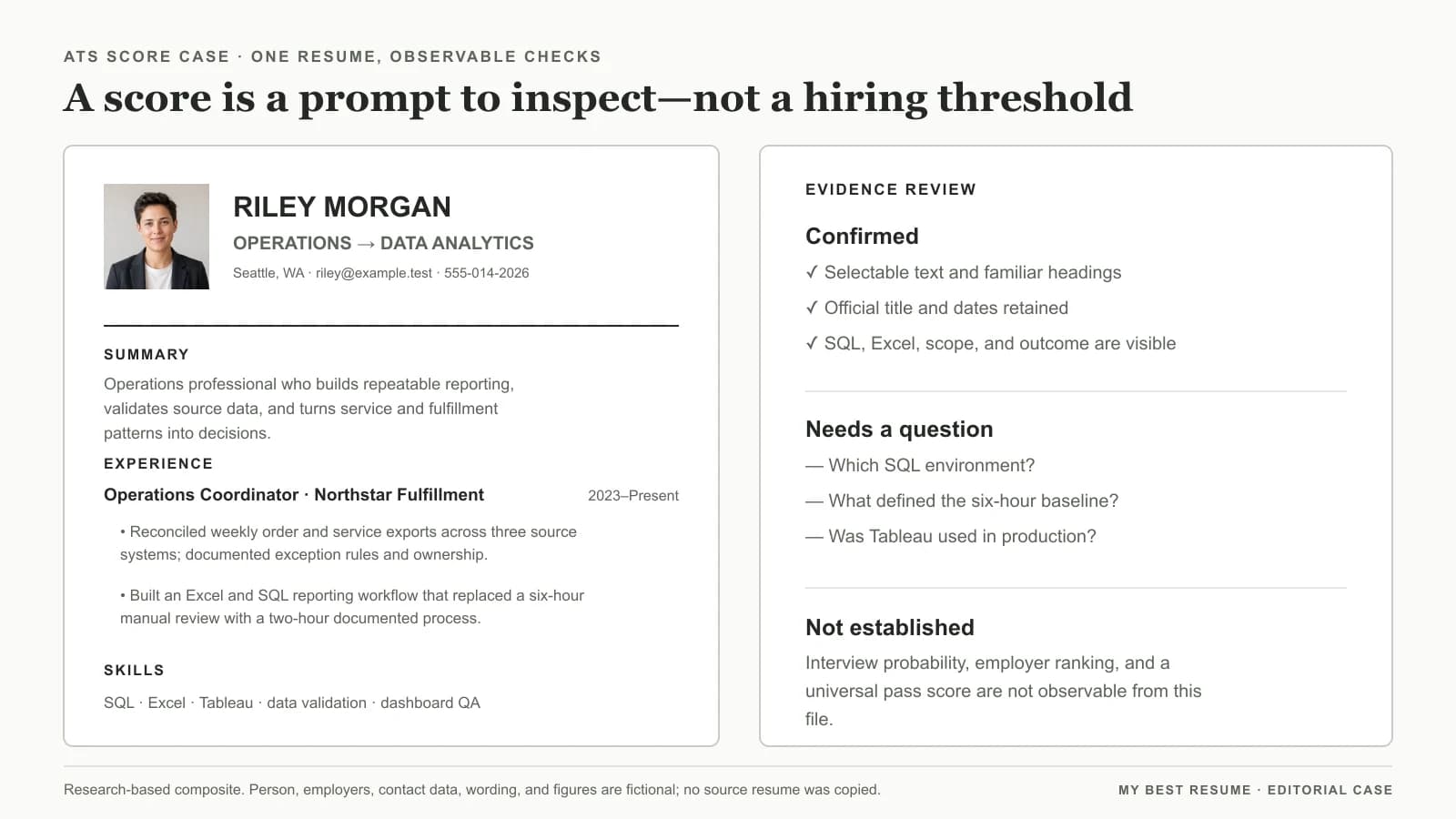
This new resume was built from the internal Data Analyst knowledge base's public-safe structure and evidence rules. The private library contains 40 source-linked university examples and a 200-posting official-ATS metadata layer, but its rights policy forbids copying any source person's experience, wording, or numbers. Riley, the employers, contact details, facts, and portrait are therefore completely fictional.

Swipe horizontally to inspect Riley's resume and evidence review

A fictional Riley Morgan resume beside confirmed evidence, follow-up questions, and claims the resume cannot establish.
Research-based composite, not a customer resume. Riley is an AI-generated fictional person; source samples were used only to study structure. The photo belongs to this editorial case study—most U.S. application resumes should remain photo-free.

Confirmed from the document

Familiar headings, selectable text, official title and dates, SQL and Excel wording, three-system scope, and a defined before-and-after are visible.

Needs Riley's evidence

The SQL environment, the six-hour baseline source, Tableau depth, contribution boundaries, and confidentiality limits require follow-up.

Cannot be inferred

No resume file establishes an employer ranking, universal ATS pass, candidate quality, interview probability, or hiring outcome.

Replace one mystery number with four observable checks

Run the review in an order you can verify

  1. 01

    Test the exact exported file

    Follow the employer's accepted file type and size, then confirm the text can be selected and copied in a sensible order. Do not test only an editor preview.

    Check: Name, contact, headings, employers, titles, dates, bullets, skills, and education remain findable.

  2. 02

    Separate hard requirements

    List required authorization, location, license, degree, tenure, and named tools separately. Mark each as supported, adjacent, missing, or not applicable.

    Check: No requirement is converted into a fact merely to increase coverage.

  3. 03

    Map priority work to evidence

    For the most important responsibilities, point to the resume line that proves action, context, scope, and outcome. A keyword without work evidence remains weak.

    Check: The top third makes the target direction and strongest two or three proof points easy to locate.

  4. 04

    Turn gaps into questions

    Ask for the missing tool depth, denominator, timeline, ownership, or outcome. Delete the term if the candidate cannot support it.

    Check: Every final claim can be explained consistently in the application and interview.

When score improvement is legitimate

Raise the score only when the edit also improves truthful communication

Checker suggestionGood editBad editDecision
Missing job termUse the employer's term where it accurately names Riley's existing workAdd a tool, license, or responsibility Riley never hadTruth decides
Weak keyword frequencyClarify one summary or bullet where the concept mattersRepeat the same noun through summary, skills, and every bulletHuman readability decides
Unclear section headingRename a creative heading to Experience, Skills, or EducationRebuild the whole resume around a vendor-only templateExtraction decides
No measurable resultRecover a documented count, time, scale, quality, risk, or decision outcomeInvent a percentage because the checker rewards numbersEvidence decides
Low semantic similaritySurface relevant supported work and remove unrelated detailMirror the posting sentence by sentenceRelevance decides

If you want a two-document comparison, the Resume–Job Matcher separates direct evidence, adjacent evidence, missing proof, and unverified requirements. Its visible count is not an ATS score or hiring prediction.

The stopping rule

Stop optimizing when the next point would damage the application

Stop

The checker asks for a credential, title, skill depth, tenure, or outcome you cannot prove.

Stop

The resume already uses the correct term in a strong evidence line and the requested repetition would make it mechanical.

Stop

A formatting change raises the checker score but makes the actual PDF harder to scan or breaks the employer's instructions.

Continue

The edit corrects extraction, surfaces relevant proof, removes unsupported wording, or answers a real hard requirement more clearly.

ATS score FAQ

Questions behind the number

What is a good ATS score for a resume?

There is no universal good ATS score. A third-party checker score is useful only inside that product's documented rubric. Employer systems can use different parsing, search, screening questions, calibrations, and human review—or no resume match score at all.

Is 80% a good ATS score?

Eighty percent may be a product-specific editing threshold, but it is not a universal employer pass mark. Ask what the score measures, whether the job requirements are weighted, and which changes would require unsupported claims or keyword repetition.

Do employers see the same ATS score that I see online?

Usually not. An external checker applies its own rubric and does not know every employer's configuration. Some employer products can generate role-calibrated match signals, but those depend on the recruiter's criteria and are not the same as a public checker score.

Should I add every missing keyword to raise the score?

No. Add a term only when it accurately names experience, knowledge, or a requirement you can prove. Leave unsupported credentials, tools, tenure, and results as honest gaps. Repetition without evidence can make the resume worse for a human reader.

How can I test whether my resume is ATS friendly?

Follow the employer's file instructions, use familiar section headings, confirm that text is selectable, inspect the extracted reading order, and compare hard requirements with visible evidence. Those checks are observable even when a score is not.

Editorial method

Primary vendor documentation anchors what parsing, employer calibration, and structured scorecards actually do. The private Data Analyst knowledge base supplies a public-safe evidence framework and aggregate research scope; no sample resume content is republished. Reddit is used only to identify recurring score anxiety, not as evidence of employer behavior.

Sources reviewed

Inspect the evidence instead of chasing an unknown cutoff

Use the free ATS readability check for observable file and structure issues, then compare the resume with one real job description without turning the result into a hiring prediction.

Run the ATS readability check