Resume strategy · 14 minute practical guide

Are Cover Letters Worth It in 2026? When to Write One—and When to Skip It

Write a cover letter when it is required or adds a specific evidence bridge; skip an optional letter that only repeats the resume or ignores application instructions.

My Best Resume Editorial TeamReviewed by Jenny Zhuang · FounderReviewed August 3, 2026Published Updated

The answer first

Write a cover letter when it is required or adds a real evidence bridge.

A cover letter is worth the time when it changes what the reader understands: why a career transition is credible, how two resume facts connect to this employer's problem, why a referral matters, or what context a short resume cannot hold. It is not worth writing just to paraphrase your experience section.

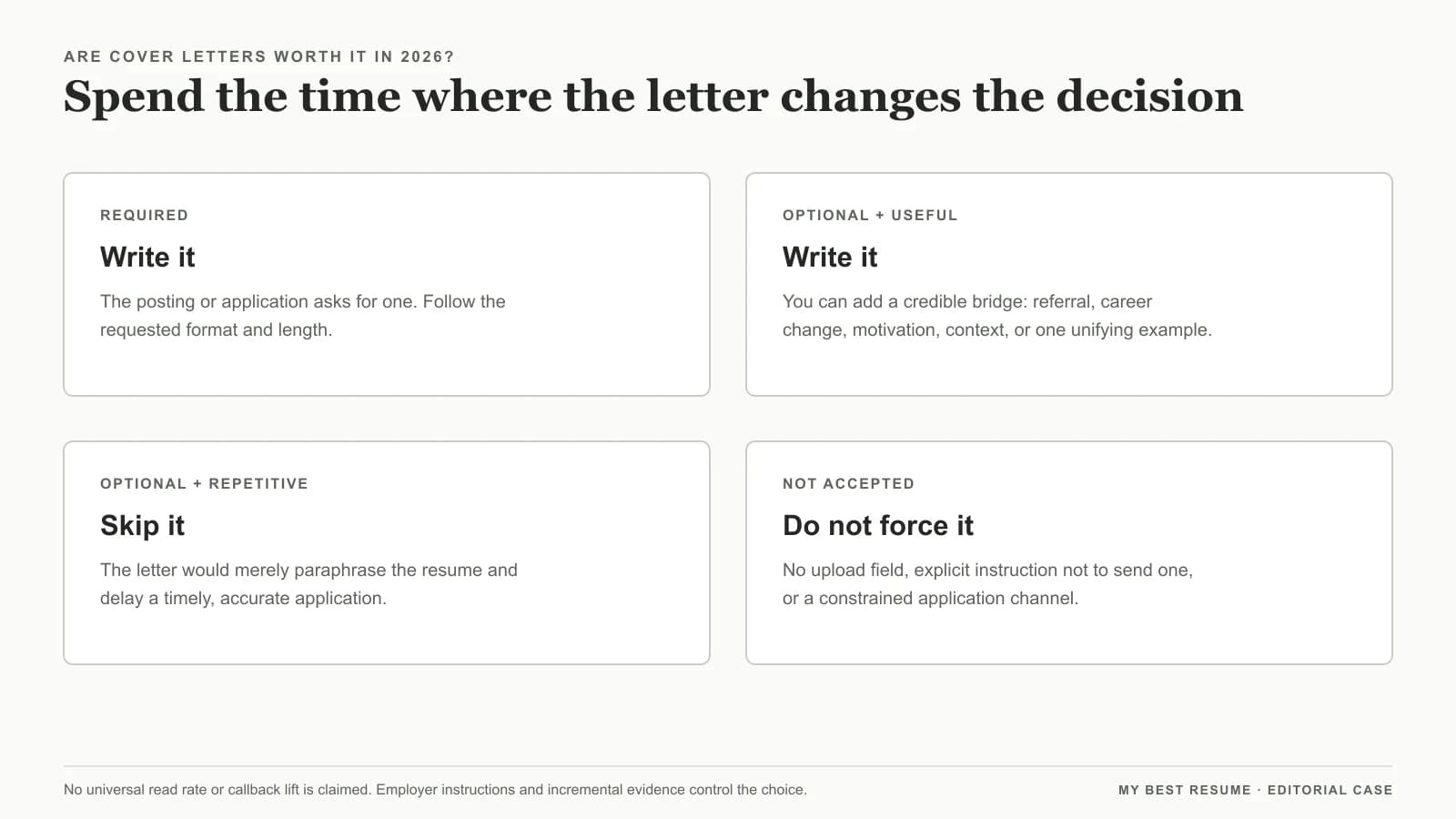
  • Required → follow the instructions and write it
  • Optional + useful context → write a concise tailored letter
  • Optional + resume repetition → skip it
  • Not accepted → do not force an extra attachment or email

Required, useful, repetitive, or not accepted

Decide before you draft

The Reddit debate often asks whether cover letters work in general. A better question is whether this employer requests one and whether your letter adds decision-relevant evidence for this role.

Swipe horizontally to compare the four cover-letter decisions

Four cover-letter decisions: required, optional and useful, optional and repetitive, and not accepted.
Original decision map. No universal cover-letter read rate or callback lift is claimed; employer instructions and incremental evidence control the choice.
Application stateDecisionUseful contentWasteful content
Cover letter requiredWrite and submit itDirect response to the requested criteria in the requested formatA generic template that ignores the prompt
Cover letter optionalWrite only if it adds a bridgeReferral, transition, context, motivation, or one employer-specific exampleA prose version of the resume
Email applicationUse the email body when appropriateShort target, evidence, and attachment noteA blank email plus unexplained files
No upload field or instruction says not to send oneDo not force itUse the resume and required application fieldsUnrequested outreach that bypasses instructions
Deadline is nearProtect application accuracy firstA short checked letter only if requiredRushing a fabricated or error-filled letter

Concrete case · Riley Morgan

Riley’s letter explains a title transition the resume cannot resolve alone

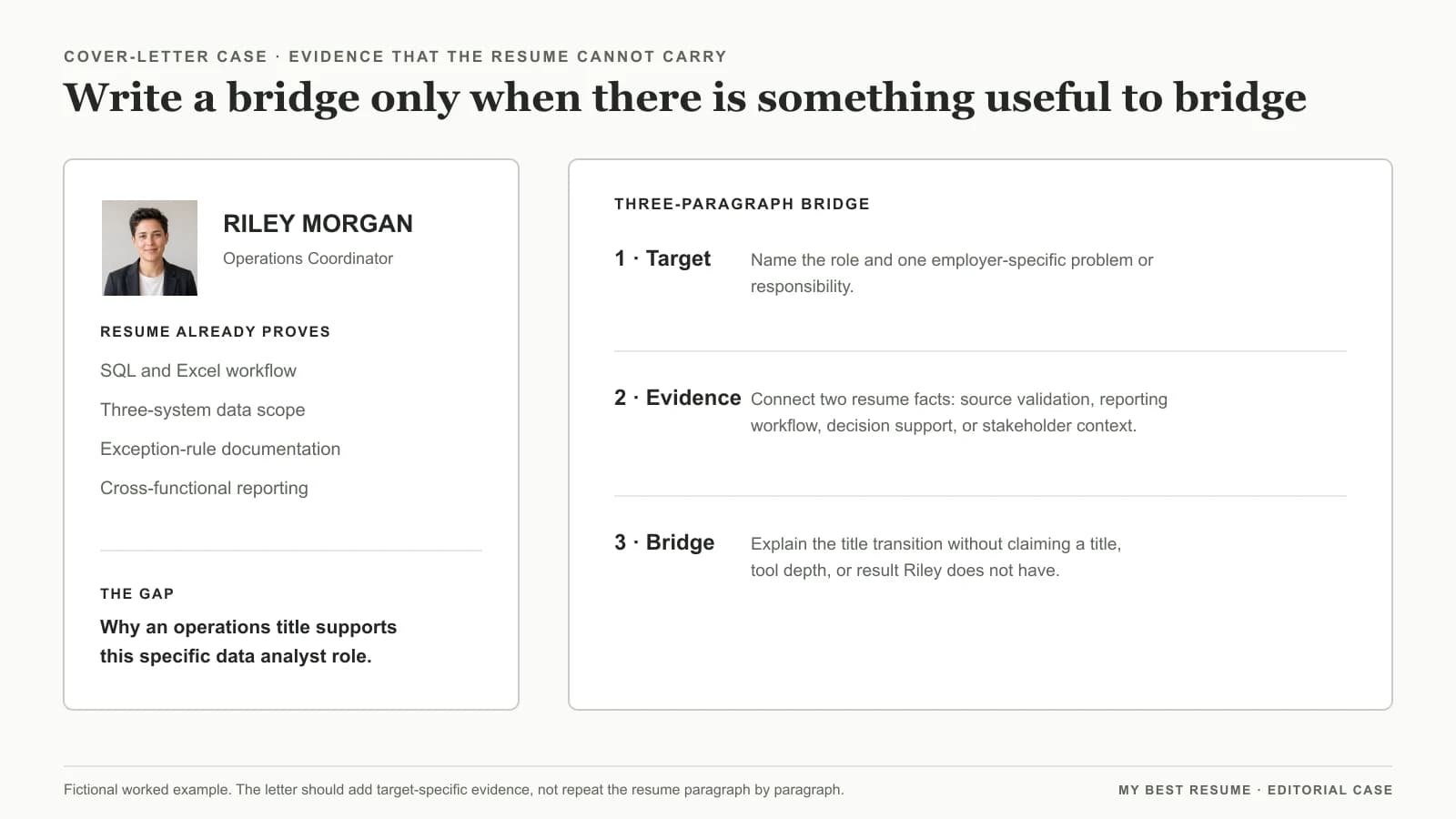
Riley's official title is Operations Coordinator, while the target is Data Analyst. The resume already proves SQL and Excel workflow, three-source reconciliation, exception rules, and cross-functional reporting. The letter's job is to connect that evidence to this employer's analyst work—not to invent analyst tenure.

Swipe horizontally to inspect Riley's resume-to-cover-letter bridge

A fictional Riley Morgan resume evidence list mapped into a three-paragraph cover-letter bridge.
Research-based composite with an AI-generated fictional person. The internal knowledge base informed structure and evidence categories only; no source resume or personal history was copied.

Paragraph 1 · Target

Name the Data Analyst opening and the employer-specific responsibility Riley can genuinely address: trusted operational reporting from imperfect source data.

Paragraph 2 · Evidence

Connect the three-source reconciliation process, documented exception rules, SQL and Excel workflow, and the internal audience that used the result.

Paragraph 3 · Bridge

State that Riley is moving from operations into a formal analytics role because the target work builds on verified analysis responsibilities—not because the prior title can be relabeled.

A short evidence-led letter

Use three paragraphs and one job-specific through-line

  1. 01

    Open with the target

    Name the role and one precise reason the employer's work is relevant to your verified background. Research only from current employer-controlled sources.

    Check: The opening could not be sent unchanged to ten unrelated employers.

  2. 02

    Prove one useful pattern

    Choose two or three resume facts that form one story: problem, method, scope, and result. Add context rather than repeating bullet wording.

    Check: Every tool, number, partner, and outcome appears in the fact ledger.

  3. 03

    Explain the bridge

    For a transition, gap, relocation, or unusual background, explain the connection briefly and positively without oversharing protected or private information.

    Check: The explanation is consistent with the resume and application form.

  4. 04

    Close with the next step

    Restate interest, thank the reader, and point to the attached resume or portfolio where useful. Avoid pressure, flattery, or a promise you cannot support.

    Check: The contact details, role name, employer name, and attachments are correct.

The optional-letter test

Write only if you can answer at least one useful question

Why this employer?

You can point to a current product, mission, customer, operating problem, or role responsibility—and connect it to your evidence without invented enthusiasm.

Why this transition?

The resume title or chronology needs one concise bridge, and your facts make the move credible.

Why this person?

A genuine referral or prior interaction is relevant and you have permission to name it.

Why this evidence?

One example needs context that would overcrowd a resume bullet but materially strengthens the target case.

None of the above

Skip the optional letter, submit an accurate targeted resume, and spend the saved time on another high-fit application or employer research.

If your bridge is an employment gap, first decide what belongs in the resume and what can remain private in the employment-gap guide. If it is a broader role change, use the career-change evidence method.

Before sending

Run a claim, relevance, and submission audit

AuditPass conditionFailure signalFix
InstructionsCorrect file, format, prompt, recipient, and lengthGeneric letter ignores an application questionRewrite to the request or omit if optional
Incremental valueLetter adds context not already obvious in the resumeEvery paragraph restates a bulletChoose one bridge or skip
Fact integrityEvery claim has a resume, source note, or personal recordAI supplied a motivation, metric, tool, or employer factVerify, rewrite, or delete
Employer specificityAt least one current employer fact connects to Riley's evidenceOnly company-name swapping changes the letterResearch one relevant responsibility or problem
VoiceRiley can explain and defend every sentence aloudLanguage feels inflated, vague, or unlike the candidateShorten and use ordinary language
ConsistencyTitle, dates, credentials, location, authorization, and attachments agreeLetter creates a second career storyReconcile before submission

Cover-letter FAQ

Spend the time where it adds evidence

Are cover letters still worth it in 2026?

Yes when the employer requires one or the letter adds a specific evidence bridge the resume cannot carry efficiently. An optional letter is usually not worth the time when it merely repeats the resume or ignores a fast-moving deadline.

Should I submit a cover letter if it is optional?

Submit one when you can explain a credible referral, career transition, employment-gap context, motivation tied to the employer's work, or one unifying example. Skip it when you have nothing job-specific to add.

How long should a cover letter be?

CareerOneStop currently suggests about 200–400 words in three or four short paragraphs. Employer instructions control. A concise letter with one evidence bridge is stronger than a full page of resume repetition.

Can I use AI to write a cover letter?

Use AI to organize verified facts and draft alternatives, then rewrite in your own voice and fact-check every claim. Do not let a model invent employer research, personal motivation, referrals, metrics, tools, or responsibilities.

Do recruiters read cover letters?

Practices vary by employer, role, stage, and application channel. We do not publish a universal read rate. Write only when the letter is required or adds enough decision-relevant information to justify the time even if it receives a brief review.

Editorial method

CareerOneStop supplies the current required-versus-optional decision, 200–400-word range, structure, tailoring guidance, and AI editing boundary. University guidance reinforces following application instructions and connecting criteria to evidence. Reddit is used only to identify the recurring worth-it question; individual hiring opinions are not converted into a read rate or callback claim.

Sources reviewed

Build the evidence bridge before drafting the letter

Compare your resume with one target job to identify direct evidence, adjacent evidence, missing proof, and the one transition the cover letter may need to explain.

Map resume evidence to the job