Resume strategy · 16 minute practical guide

Do You Need a Skills Section on Your Resume? A Role-by-Role Guide

Decide whether a resume skills section helps your role, choose specific capabilities, place them clearly, and connect every priority skill to credible evidence.

My Best Resume Editorial TeamPublished Updated

The answer first

Keep a skills section only when it makes relevant capability easier to find.

A skills section on a resume is not mandatory, and it is not an ATS password. It earns its space when a recruiter needs to confirm tools, methods, languages, credentials, or domain knowledge quickly. Keep it for useful retrieval; remove it when it becomes a list of claims the rest of the resume never proves.

  • List specific, defensible skills
  • Group them by how the role thinks
  • Prove priority skills in experience or projects
  • Remove generic adjectives and rating bars
A fictional recruiter comparing a compact resume skills section with evidence in the experience section.
AI-generated editorial photograph. The recruiter and resume are fictional; no applicant data, employer record, ATS score, or hiring prediction is shown.

The decision rule

Ask four questions before adding the section

The useful question is not “Do modern resumes have a skills section?” It is “What information would be harder to find or trust without this section?”
  1. 01

    Does the target role name specific capabilities?

    Read several current job descriptions for the same role family. Separate required tools, methods, credentials, knowledge, and languages from broad personality language.

    Check: You can point to a repeated, role-specific requirement—not one stray keyword.

  2. 02

    Can you use each item at a defensible level?

    Keep skills you could discuss, demonstrate, or apply on the job. Exposure from one tutorial should not be presented like production experience.

    Check: You can explain where you used it, how recently, and what you produced.

  3. 03

    Is the evidence already easy to see?

    If SQL, bilingual patient communication, or inventory planning already appears clearly in several recent bullets, a short list may still help retrieval. A second long list probably adds repetition.

    Check: The section reduces search effort instead of duplicating whole sentences.

  4. 04

    Is this the best use of the space?

    Compare the section with the evidence you would cut to make room. A compact technical list may beat one weak bullet. A generic list should not displace a relevant achievement or project.

    Check: Every line helps the reader evaluate fit for this target.

Role-by-role guide

The answer changes with the occupation

O*NET separates occupation-specific tasks, skills, work activities, and technology requirements because different jobs signal competence differently. Use the same logic on the resume: match the section to the evidence a role actually requires.
Role familySkills section?What to listWhat still needs proof
Software, data, engineeringUsually keep itLanguages, frameworks, databases, cloud platforms, testing or analysis tools, and role-specific methods you can use.Repeat the most important tools inside project or experience bullets that show what you built, changed, measured, or maintained.
Healthcare and licensed workKeep, but separate credentialsClinical systems, procedures, languages, equipment, and verified specialties. Put licenses and certifications in their own clearly labeled area when status or jurisdiction matters.Experience should show patient population, setting, volume, coordination, quality, or safety—not only a list of clinical terms.
Skilled trades and operationsOften keep itEquipment, safety standards, maintenance methods, quality systems, inventory tools, scheduling platforms, or regulated processes.Bullets should connect the method to uptime, throughput, quality, safety, response time, cost, or team scope.
Student or recent graduateKeep when it adds concrete evidenceRelevant lab methods, software, research techniques, languages, or tools used in substantial coursework, internships, or projects.A project section must show where the skill was applied. A long list of course exposure is not the same as working proficiency.
Marketing, sales, HR, financeUse selectivelyRole-specific platforms, research or reporting methods, compliance knowledge, CRM or analytics tools, and relevant languages.Prove judgment and outcomes in experience: audience, pipeline, forecast, hiring volume, process, controls, or business result.
Senior leadership and general managementOften shorten or omitA few decision domains, operating systems, or sector-specific capabilities when they clarify the target.Leadership credibility comes mainly from scope, decisions, transformations, teams, budgets, risk, and outcomes—not a dense keyword bank.

What belongs in the section

Prefer precise nouns over flattering adjectives

A useful skills section lets a reader identify capability without decoding vague self-description.

Tools and technologies

Name the specific software, languages, equipment, platforms, or systems that matter to the target and that you can actually use.

O*NET tracks occupation-specific technology requirements because tools vary sharply by job.

Methods and standards

Include concrete practices such as financial modeling, root-cause analysis, GMP, usability testing, or statistical process control when they are relevant and supported.

Languages

Use an understandable level such as native, professional working proficiency, or conversational. Do not imply professional fluency from classroom study alone.

Licenses and certifications

Show the verified credential, issuer or jurisdiction when relevant, and active status or expiration only when accurate. A separate section is often clearer than mixing credentials with tools.

Domain knowledge

Use a small number of concrete domains—such as B2B SaaS onboarding, revenue recognition, or sterile processing—when they distinguish your fit and appear elsewhere in the resume.

Soft skills

Translate them into evidence. Replace “leadership” with the team, decision, change, or result; replace “communication” with the audience, message, and outcome.

List versus evidence

A keyword can improve findability; a bullet makes it believable

The strongest resume uses both layers selectively. The list answers “what?” while experience or projects answer “where, how, and to what effect?”

Before

Skills: Leadership, communication, problem-solving, Excel, reporting, teamwork, organization

After

Analysis: Excel, Power Query, monthly variance reporting
Operations: Capacity planning, SOP design, vendor coordination
Why this works: The revised list is specific and grouped. The experience section must still show the workbook, decision, operating change, audience, or result produced with those capabilities.
Skill claimEvidence that makes it credible
Excel and Power QueryBuilt a refreshable capacity model that replaced four manually combined spreadsheets and cut weekly preparation from three hours to forty minutes.
Cross-functional facilitationLed a weekly issue review across operations, finance, and customer support; converted unresolved cases into owners, dates, and escalation rules.
Spanish — professional working proficiencyUsed Spanish in recurring customer onboarding calls and translated approved support materials for a Latin American rollout.
Root-cause analysisReviewed repeat quality failures by cause and shift, then changed the inspection sequence and reduced rework in the following quarter.

If your bullets still read like duties, use the Challenge–Action–Outcome resume bullet method to expose the evidence behind the skill.

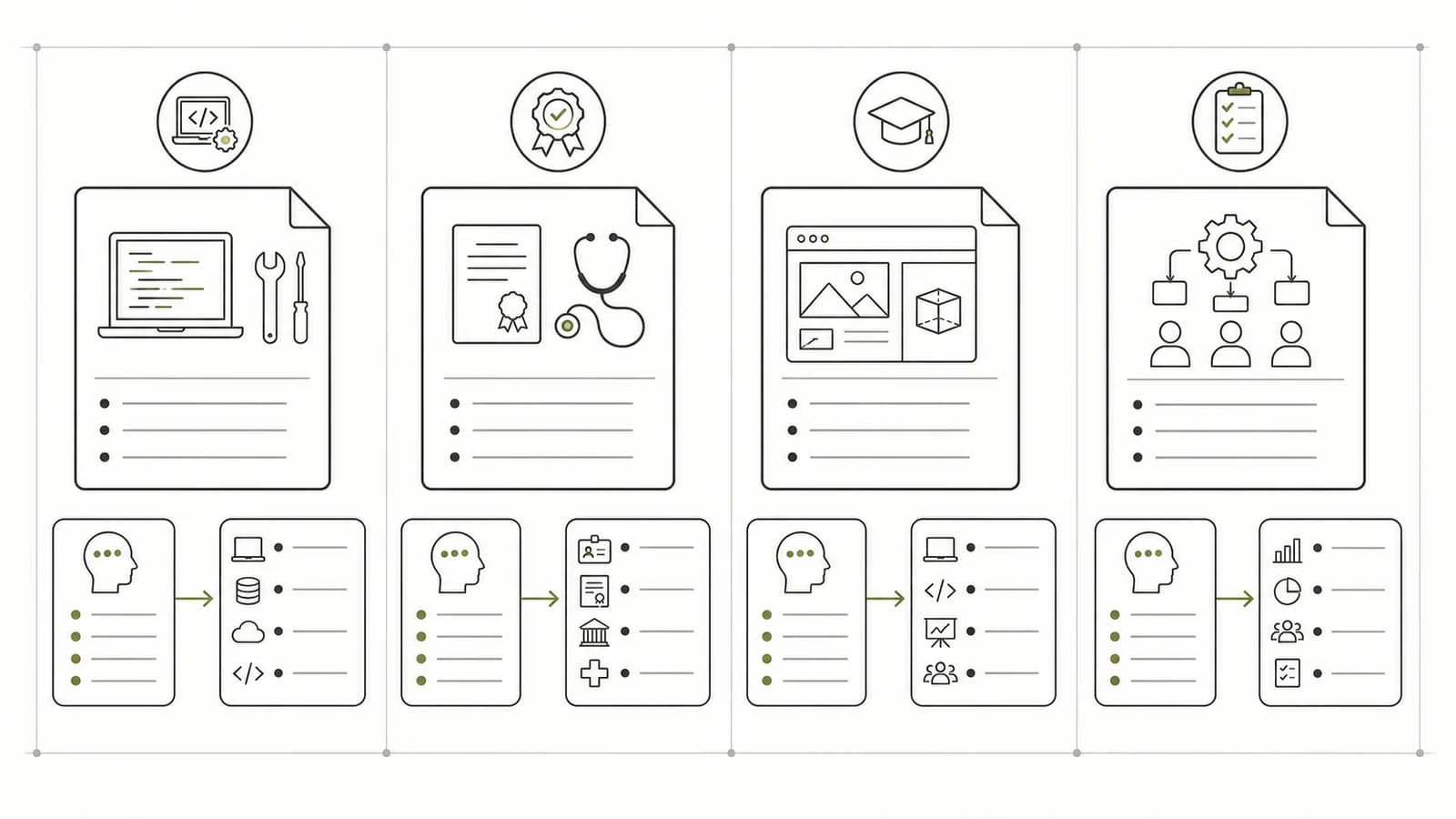
Four fictional resume situations linking technical, licensed, student, and operations skills to supporting evidence.
AI-generated editorial illustration. The four paths are conceptual; the role-by-role decisions and examples are provided in the HTML tables above.

Order and labeling

Place the section where it answers the reader’s next question

There is no universal top-or-bottom rule. Order should reflect what the target needs to confirm first.
SituationRecommended placementWhy
Technical requirement is a first-pass screenAfter the headline or summary, before experienceThe reader can confirm the stack quickly, then inspect the work that proves it.
License or credential controls eligibilityA clearly labeled Licenses or Certifications section near the topStatus and jurisdiction should not be buried inside an undifferentiated keyword list.
Recent graduate with relevant projectsNear education and projectsThe section points toward the place where the capability was actually practiced.
Experienced generalist with strong recent historyBelow experience, reduced to a compact list—or omittedRecent decisions and outcomes usually carry more weight than a large inventory.
Career changerAfter a focused summary, before chronological experienceIt can translate supported capabilities, but must not disguise official titles or replace the career bridge.

ATS reality

A skills section can help retrieval, but it cannot create experience

Applicant systems vary by employer and configuration. Treat the resume as a document that must work for both text processing and human evaluation.

What the section can do

  • Make accurate role language easier to find.
  • Gather tools that would be awkward to repeat in bullets.
  • Clarify related technologies, methods, or languages.
  • Help a recruiter scan an unfamiliar technical domain.

What it cannot do

  • Guarantee an ATS pass or recruiter interview.
  • Turn exposure into working proficiency.
  • Substitute for a required license or years of experience.
  • Make unsupported keyword repetition credible.

For formatting and extraction checks, use the ATS-friendly resume guide. For job-specific prioritization, follow the master-resume tailoring workflow.

A practical workflow

Build the section from evidence, not from a buzzword list

  1. 01

    Collect target-role language

    Review several current job descriptions and an occupation source such as O*NET. Record repeated tools, methods, credentials, and domains without copying requirements you do not meet.
  2. 02

    Build a verified inventory

    For every candidate skill, note where you used it, how recently, at what level, and what evidence appears in the resume.
  3. 03

    Select the useful subset

    Choose the items that are both relevant to the target and supported by your record. Remove basic, obsolete, unrelated, or aspirational terms.
  4. 04

    Group for retrieval

    Use two or three plain categories such as Languages, Data & Reporting, and Operations Methods. Avoid an unbroken keyword wall.
  5. 05

    Reinforce the priorities

    Place the highest-value capabilities naturally in experience or project bullets, where the action and result make them credible.
  6. 06

    Test the exported file

    Copy the PDF text into a plain-text editor and confirm the section name, categories, and items appear in a sensible order.

What to remove

Six common skills-section failures

Progress bars and star ratings

Replace self-scored graphics with a clear proficiency statement or, better, evidence of use.

Generic personality claims

Move communication, teamwork, adaptability, and leadership into bullets that show the behavior.

Every tool ever touched

Remove short-lived exposure and software unrelated to the target. A smaller honest list is easier to trust.

Keywords copied from one posting

Use the employer’s accurate language only where it matches your facts. Never paste a requirement to simulate experience.

Unexplained acronyms

Use the common term and expand an acronym when the audience or industry may interpret it differently.

A list with no supporting record

Add project or experience evidence, lower the claim to an accurate level, or remove it.

Frequently asked questions

Skills-section questions, answered

Do all resumes need a skills section?

No. A skills section is useful when it helps a reader find relevant tools, methods, languages, credentials, or domain capabilities faster than the experience section alone. If it only repeats generic claims or duplicates obvious evidence, use the space for stronger experience or projects.

Should I list soft skills on my resume?

Usually not as unsupported adjectives. Communication, leadership, teamwork, and problem-solving become credible when a bullet shows the audience, decision, conflict, action, or outcome. A short role-specific capability such as stakeholder facilitation may belong in a skills section when the job uses that language and the experience section proves it.

How many skills should I put on a resume?

Use the smallest accurate set that helps with this target role. For many resumes, roughly eight to fifteen specific items across two or three categories is enough. The right number depends on the occupation; relevance and proof matter more than reaching a quota.

Does an ATS require a skills section?

No universal ATS rule requires a section named Skills. Systems can parse relevant language in experience, projects, education, certifications, and other conventional sections. A clear skills section can improve findability, but it does not replace truthful context or guarantee selection.

Should skills be listed in columns or with progress bars?

Use simple text categories that remain readable when copied into plain text. Avoid progress bars, stars, and self-assigned percentages because they have no shared standard. If you use columns, test the exported file to confirm the reading order remains understandable.

Where should a skills section go?

Technical and licensed roles often benefit from a compact section near the top, after the summary. Students may place it near education or projects. Experienced generalists can move it below experience or omit it when the work history already makes the relevant capabilities obvious.

Find the skills your resume can actually support

Compare your target role with your existing evidence, then turn missing proof into questions instead of invented keywords.

Analyze my skills

Editorial method

We compared recurring r/resumes debates about whether a skills section helps or wastes space with occupation-level skill and technology structures from U.S. Department of Labor resources. Community posts informed the questions; they were not treated as universal hiring rules.

Sources reviewed