
Resume strategy · 12 minute practical guide

Why Your Resume Gets No Interviews: A 5-Part Diagnostic

Diagnose role fit, application strategy, resume evidence, first-read clarity, and market constraints before rewriting your resume or chasing an ATS score.

My Best Resume Editorial TeamPublished Updated

The answer first

Do not diagnose a job search from the resume alone.

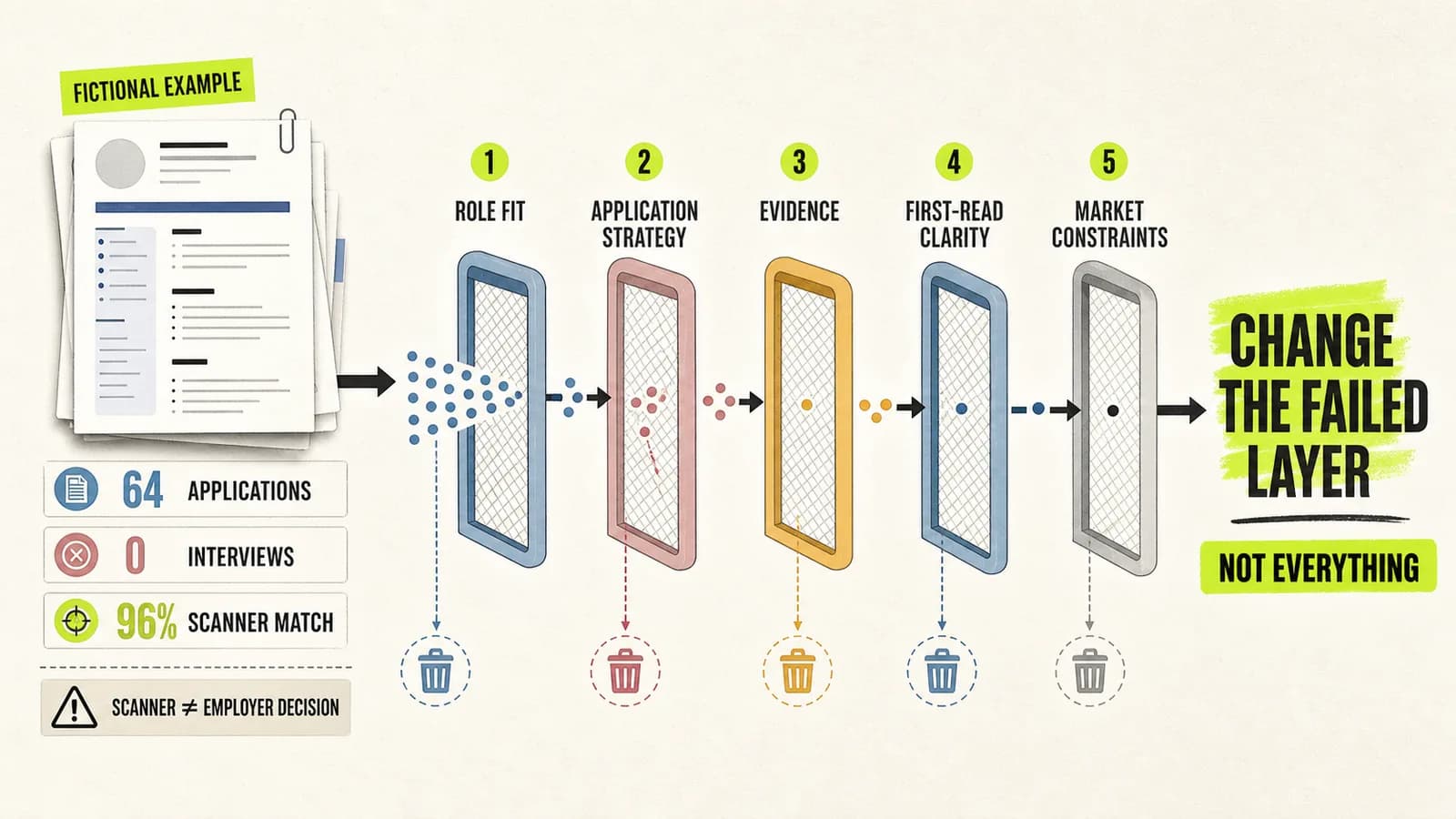
If your resume is not getting interviews, pause before rewriting every line. Review five separate layers: what you are targeting, how you are applying, what your resume proves, how clearly it reads, and what the hiring market may be doing. Change the layer with the strongest evidence of failure. A scanner score cannot make that diagnosis for you.

  • Role and level fit
  • Application channel and timing
  • Relevant evidence
  • First-read clarity
  • Market and eligibility constraints

Swipe horizontally to read the five-part diagnostic

A fictional job search with 64 applications, zero interviews, and a 96% scanner match separated into role fit, application strategy, evidence, first-read clarity, and market constraints.
Fictional diagnostic example. A scanner result can describe one document check; it cannot identify which layer of a real hiring process stopped the application.

Start with the search, not the document

A high resume score and zero interviews can both be true

Resume scanners inspect a document against their own rules. An employer decides whether to advance a candidate in a particular search. Those are not the same decision.

Complete worked example

Maya Chen

Senior Customer Success Manager → A clearer diagnostic, not an invented success story

Fictional worked example based on recurring job-seeker questions. The application counts, scanner result, career facts, and name are illustrative—not a benchmark or customer outcome.

Swipe horizontally to compare the signals.

Observed signalWhat it meansWhat it does not prove
64 applications, no interviewsMaya's current search process is not producing the next step.It does not identify the resume as the sole cause.
One scanner reports a 96% matchHer document contains many terms that this scanner expected.It is not an employer score, ranking, or interview probability.
Four different job familiesShe is testing Customer Success, Implementation, Sales, and Operations roles at once.It does not prove she is unqualified for all four.
Remote-only, national searchEvery application carries a location and competition constraint.That constraint cannot be repaired with stronger verbs.

Build a baseline you can segment

A total application count is emotionally vivid but diagnostically weak. Create a simple log with job family, level, location, work-authorization or credential requirements, date posted, date applied, source, resume version, and furthest stage. Then group similar applications before judging the result.

For Maya, “64 applications” becomes four smaller searches. Her direct Customer Success applications are the fairest test of her current evidence. Sales and Operations roles need different proof and should not be allowed to distort that result.

There is no universal application count at which the resume becomes guilty. Your useful comparison is between similar roles, versions, and channels inside your own search.

An anxious fictional job seeker pressing one hand to his forehead while reviewing a laptop, resume versions, and an application log at home.
AI-generated editorial scene with a fictional person. The anxiety may be real, but the useful next step is to compare role clusters, resume versions, channels, and evidence.

Diagnostic 1 + 2

First test who you target and how you reach them

A beautifully written resume still underperforms when it is aimed at the wrong level, spread across unrelated roles, or used in a weak application process.

01 · Role fit

Make the target narrower than “jobs I could do”

Start with the role family and level most directly supported by your recent work. A recruiter should not have to decide whether you are a customer leader, salesperson, implementation specialist, or operations generalist. Each can be credible, but each requires a different evidence order.

  • Job family: Are most applications variations of the same work, or unrelated experiments?
  • Level: Does the resume demonstrate the scope expected at that level—individual delivery, team leadership, strategy, budget, or executive influence?
  • Hard requirements: Are location, work authorization, license, degree, travel, or tenure requirements genuinely satisfied?
  • Overqualification: Could your recent title or scope make a much smaller role look temporary? Address the direction honestly; do not hide dates or demote your title.

02 · Application strategy

Treat the application channel as part of the test

Two identical resumes can enter very different queues. A fresh employer-site application, a referral, a recruiter conversation, and a one-click application are not interchangeable observations. Track them separately.

  • Apply to a real, specific role rather than sending the same document to every vaguely related opening.
  • Record how old the posting was when you applied and whether the employer still lists it on its own careers site.
  • Use relationships as a research and discovery channel—not as a request that a stranger guarantee an interview.
  • Keep follow-up professional and bounded. A thoughtful message can add context; repeated unsolicited messages create noise.

If one narrow role cluster performs better through alumni, former colleagues, direct employer applications, or recruiter conversations, improve that route. Do not conclude that “networking works” or “job boards fail” from one response.

Maya's first decision

Split Customer Success and Implementation into two defensible resume versions. Pause Sales and general Operations applications until she can state why those transitions make sense and which existing evidence supports them.

Versioning changes emphasis, not history. The complete resume-tailoring guide shows how to keep one master record while selecting evidence for a specific job.

Diagnostic 3 + 4

Then test what the resume proves and what a reader sees first

The resume matters most when the role is plausible and the application reaches a real review. At that point, evidence and clarity—not adjective density—do the work.

03 · Evidence quality

Replace claims with inspectable work

A reader needs to understand what problem you owned, what you changed, how large or difficult the work was, and what became better. Revenue is only one form of proof. Scale, time, quality, risk, adoption, safety, complexity, and responsibility can be equally useful when they are true.

Maya's source notes confirm that she owned onboarding for 38 enterprise accounts, redesigned a six-step launch process, and reduced median time to launch from 31 to 22 days. Those details are fictional here, but they demonstrate the fact boundary: a stronger bullet can use verified context; it cannot invent a result because the sentence feels incomplete.

Generic claim

Strategic, results-driven customer success leader responsible for onboarding and cross-functional initiatives.

Fictional evidence example

Redesigned a six-step onboarding process across 38 enterprise accounts, reducing median time to launch from 31 to 22 days.
Why this works: The second line names the work, scope, change, and outcome. In a real resume, every number and relationship must come from the candidate's records or explicit confirmation.

04 · First-read clarity

Make the right conclusion easy to reach

Recruiters do not all read in one fixed order or on one fixed timer. Still, your first page should answer four practical questions without a forensic reading:

  1. 01

    What role and level is this person presenting?

    Use a clear headline or summary only when it adds direction; do not upgrade the official job title.

  2. 02

    What is the strongest relevant evidence?

    Put the most useful recent bullets before less relevant duties and old history.

  3. 03

    Can I find the required skills near proof?

    A keyword in a skills list is weaker than the same skill connected to work.

  4. 04

    Can software and people read the file?

    Check extraction, headings, dates, contact details, links, and page flow.

If the job language and your proof are far apart, use the Resume–Job Matcher to separate direct evidence, adjacent experience, missing proof, and unverified requirements.

If a bullet names only a duty, use the Bullet Generator to draft from facts you supply and expose the context still missing.

If you suspect a parsing problem, run the file through the ATS Resume Checker and read the extracted text instead of chasing a universal score.

Diagnostic 5

Some no-interview problems are not resume problems

You cannot observe the full hiring decision from the outside. The point is not to guess which hidden factor rejected you; it is to stop asking the document to solve conditions it cannot control.

Competition and timing

A role may attract more qualified applicants than the team can review, or the shortlist may form while the posting remains visible.

Internal or known candidates

A public posting can coexist with an internal move, referral, or candidate already deep in the process.

Changing headcount

Budget, priority, organization design, or approval can change after a role is posted.

Location and authorization

Remote geography, time zone, sponsorship, clearance, travel, or licensing can narrow eligibility.

Level and compensation

The employer may read the candidate as too junior, too senior, or mismatched to the available scope and budget.

Industry conditions

Hiring demand varies by occupation, company stage, specialty, and region. One broad market story rarely explains every application.

What should change instead?

If sponsorship, licensing, geography, or level explains the mismatch, change the target set or state the relevant eligibility clearly. Do not hide an official title, omit dates to disguise seniority, or add a credential you do not hold.

If the likely issue is competition or uncertain headcount, diversify how you discover roles and gather information. Former colleagues, professional groups, alumni, recruiters, and direct employer sites can reveal different opportunities. They still do not guarantee access or a response.

When the external factor cannot be verified, label it unknown. That is more useful than rewriting the summary for the twelfth time to explain silence the resume may not have caused.

A controlled next step

Change one layer, then compare a similar batch

The goal is not to discover one permanent answer. It is to make the next set of applications more interpretable than the last.

Swipe horizontally to compare all four columns.

Pattern in your logMost useful next changeWhat to hold steadyTool or record
Unrelated job families share one resumeCreate one version per defensible role clusterDates, employers, titles, and verified outcomesMaster resume + version label
Direct-fit roles, but weak or generic bulletsRecover scope, ownership, difficulty, and outcomeTarget family and application sourceEvidence notes + Bullet Generator
Strong evidence, but unclear first pageMove target direction and relevant proof forwardThe underlying facts and role clusterHuman read + extracted-text check
Requirements vary sharply by postingMap each serious job to supported and missing evidenceOne base version for that role familyResume–Job Matcher
Remote, sponsorship, license, or level mismatchRefine the target set and eligibility languageResume wording unless it is genuinely unclearApplication log
  1. 01

    Segment the old applications

    Group them by job family, level, location, requirement fit, source, timing, and resume version.

    Output: a comparable baseline

  2. 02

    Choose the weakest supported layer

    Pick role fit, strategy, evidence, clarity, or a search constraint only when the log gives you a reason.

    Output: one testable diagnosis

  3. 03

    Make one substantial change

    For example, narrow the role cluster or rebuild the first-page evidence. Avoid changing format, keywords, channels, and target level at once.

    Output: one named resume or search version

  4. 04

    Review the next similar batch

    Track the same fields and compare stages, not just rejections. Keep, revise, or reject the diagnosis based on your own pattern.

    Output: a better next decision

The short version

If your resume gets no interviews, the right question is not “What should I rewrite?” It is “At which layer does my evidence first stop supporting the next step?”

Fix obvious contact, extraction, and eligibility errors immediately. For everything else, narrow the target, compare like with like, improve the proof, and make one controlled change. Your resume is one part of the system—not a verdict on your value and not an explanation for every employer decision.

Editorial method

We reviewed the current US-English search results and recent, yearly, and all-time discussions in r/resumes. Reddit posts are used as qualitative evidence of recurring questions and strategies, not as representative labor-market data, causal proof, or hiring benchmarks. Product limits were checked against the live My Best Resume analyzer, matcher, bullet, and ATS-checker behavior.

Sources reviewed

Check what your resume actually communicates

The free Resume Analyzer can surface your strongest signals and missing evidence before you rewrite. It cannot identify hidden employer decisions, measure the labor market, or predict an interview.

Analyze my resume