U.S. job search · 14 minute practical guide
Working Remotely for a U.S. Company From Abroad: Employee, EOR, or Contractor?
Compare direct employment, employer-of-record arrangements, and contracting when the work is performed abroad, including key compliance questions.
The answer first
The location of the worker changes the employment problem.
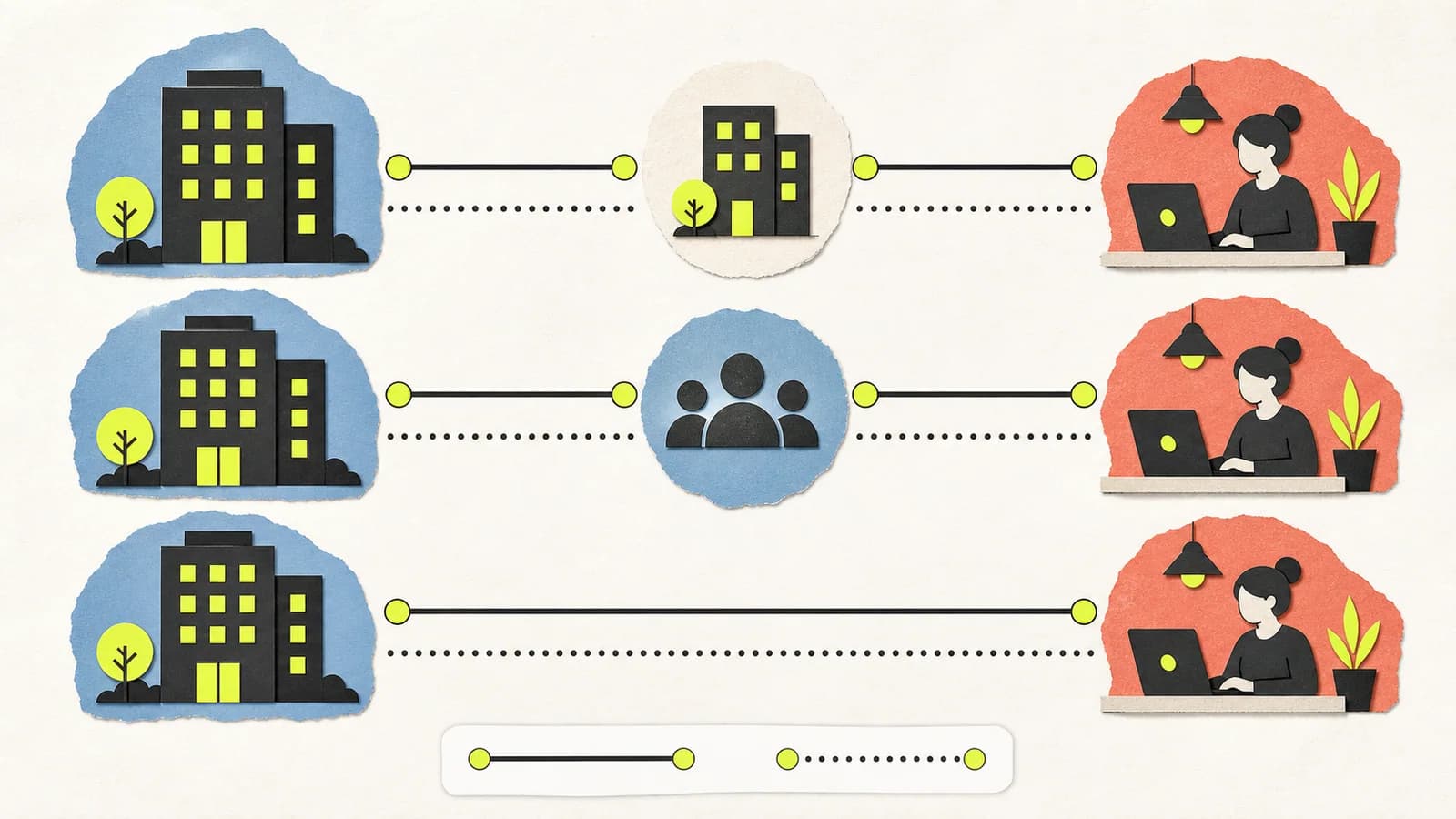
If you perform the work outside the United States, the main questions are usually the law, payroll, tax, benefits, classification, and work authorization of the country where you actually work—not simply whether the client is American. The common structures are direct employment through a local entity, employment through an EOR, or a genuinely independent contractor relationship.
- Country where work is performed
- Legal employer or contracting party
- Control and independence
- Local payroll, tax, and benefits

Three structures
Start by identifying who employs—or contracts with—you
Use these checks as a research framework. Individual immigration, employment, and tax conclusions require advice for the actual person, employer, role, and country.
An EOR is an operating model, not an immigration category. It can help a company employ people in a country where it lacks its own entity, but it does not erase local employment rules or guarantee that every role and country can be supported.
Swipe horizontally to compare the details.
| Structure | How it usually works | Questions to resolve |
|---|---|---|
| Direct employee | The U.S. company’s local subsidiary or branch employs you and runs local payroll. | Which entity signs, local benefits, payroll withholding, policies, and reporting line. |
| Employer of record (EOR) | A local EOR is the legal employer while the U.S. company directs day-to-day work under a service arrangement. | Who controls what, contract terms, benefits, termination process, data access, and EOR coverage. |
| Independent contractor | You or your business provides services under a commercial agreement and handles appropriate local obligations. | Real independence, scope, fees, tools, schedule, tax, insurance, IP, and termination. |
Physical work location
Where the services are performed is a foundational fact
That U.S. tax sourcing rule does not answer the worker’s entire tax position or the employer’s obligations in another country. Local payroll, social insurance, labor protections, permanent-establishment risk, data rules, and the worker’s right to work in that country may still apply.
If you travel while working, the answer can change by day and jurisdiction. “Work from anywhere” is a marketing phrase, not a compliance analysis. Tell the company where you will physically work and whether you plan to move.
Employee or contractor
The contract label cannot replace the real relationship
Use these checks as a research framework. Individual immigration, employment, and tax conclusions require advice for the actual person, employer, role, and country.
- Employee indicators may include required hours, close supervision, company-provided tools, integration into ongoing operations, exclusivity, and employee-type benefits.
- Contractor indicators may include control over method and schedule, multiple clients, business risk, invoicing, own equipment, defined deliverables, and the ability to profit or lose.
- No single factor decides every case. A full-time schedule or long relationship does not automatically settle classification, but it should trigger a careful review.
- Misclassification can create wage, tax, benefit, penalty, and intellectual-property risks for both sides.
Before accepting
Get the operating facts in writing
Use these checks as a research framework. Individual immigration, employment, and tax conclusions require advice for the actual person, employer, role, and country.
- Which legal entity signs the agreement, and under which country’s law?
- Am I an employee of that entity, an EOR employee, or an independent service provider?
- Who pays me, in what currency, and who handles withholding, social insurance, benefits, expenses, and tax documents?
- Where may I physically work, and what notice is required before travel or relocation?
- Who owns work product, provides equipment, controls security access, and handles personal data?
- What are the probation, leave, working-time, termination, notice, and dispute terms?
Offer comparison
Compare total working conditions, not a headline dollar amount
Use these checks as a research framework. Individual immigration, employment, and tax conclusions require advice for the actual person, employer, role, and country.
For employment, identify gross pay, pay frequency, currency, withholding, statutory contributions, paid leave, health or retirement benefits, expense reimbursement, equipment, overtime or working-time rules, notice, severance, and local holidays. Ask whether the U.S. company or the local employer controls compensation reviews and promotions.
For contracting, estimate business taxes, social contributions, health coverage, unpaid leave, accounting, currency conversion, transfer fees, equipment, insurance, and downtime between projects. A contractor fee may need to be materially higher than an employee salary to produce comparable net value and risk protection.
Review intellectual-property, confidentiality, data-security, and invention-assignment language. Cross-border agreements sometimes import broad U.S. templates that conflict with mandatory local rights or create obligations unrelated to the services. Independent country-specific review is especially valuable before accepting exclusivity, non-compete, indemnity, or unlimited-liability terms.
- Ask who carries exchange-rate risk and what happens when a payment date falls on a local banking holiday.
- Confirm which country’s public holidays and working hours apply, especially for teams that expect U.S. time-zone overlap.
- Model a termination scenario: final pay, notice, unused leave, equipment return, access shutdown, and ownership of unfinished work.
Choosing a model
Match the structure to the reality of the work
For a company, the decision depends on country coverage, cost, duration, hiring volume, control, benefits, and risk. For a worker, compare net compensation, stability, statutory protections, benefits, tax administration, currency risk, intellectual-property terms, and career expectations.
Before signing, obtain country-specific advice. A U.S.-focused blog cannot determine employment classification, tax residence, permanent establishment, immigration permission, or mandatory benefits across jurisdictions.
Common questions
Short answers before you act
- Do I need a U.S. work visa to work remotely from another country?
- A U.S. work visa is generally tied to work performed in the United States. If all services are performed abroad, local permission to live and work there is usually the immediate immigration question. Travel, relocation, and country-specific facts can change the analysis.
- Who is my employer in an EOR arrangement?
- Typically the local employer-of-record entity is the legal employer and handles local payroll and employment administration, while the client company directs day-to-day work under a commercial agreement. Read the contracts because responsibilities, benefits, and termination processes vary.
- Is hiring someone as a contractor always simpler?
- No. Genuine contracting can suit independent business services, but a contract label does not cure employee-like control. Misclassification, tax, intellectual-property, data, benefit, and permanent-establishment risks may remain. Both parties need country-specific review of the real relationship.
- Can remote work abroad lead to a later U.S. transfer?
- It can build relationships and evidence of business value, but it creates no automatic immigration benefit. A later move needs a qualifying category, employer relationship, role, timing, and filing process of its own. Treat any relocation statement as provisional until confirmed in writing.
Continue the research
Related U.S. job-search guides
- Compare remote work with U.S. relocation routes
Choose the outcome before choosing the structure.
- Write a U.S. resume with overseas experience
Make cross-border scope legible.
- Verify sponsorship for U.S.-based work
Do not confuse overseas remote hiring with sponsorship.
Editorial method
Reviewed July 28, 2026. We prioritized current U.S. government and university career-center material, separated historical data from present employer policy, and avoided predicting individual immigration outcomes. This educational guide is not legal, tax, or employment advice.
Sources reviewed
- IRS source of personal-service income
Official U.S. rule centered on where services are performed.
- IRS common-law employee guidance
Behavioral control, financial control, and relationship factors.
- IRS Publication 515
U.S. withholding guidance for nonresident aliens and foreign entities.
- SSA international agreements
Official overview of U.S. Social Security totalization agreements.
Present remote experience as business evidence.
Whether you are an employee or contractor, your resume should show verified scope, collaboration, decisions, and outcomes—not legal labels you cannot support.