CV-first registration
A candidate profile is created around an uploaded CV, which is required for job applications on the platform.
Job-site resume guide
CV-Library builds a candidate profile around an uploaded CV. Unless the CV is hidden, recruiters may search and contact the candidate; most applications use the registered file plus an editable cover letter, while some vacancies offer Quick Apply.
My Best Resume is independent and is not affiliated with, endorsed by, or sponsored by CV-Library. CV-Library and its related marks belong to their respective owner.
Live evidence check
Paste the complete listing from CV-Library. The matcher separates direct support, adjacent experience, missing evidence, and hard requirements so you can decide what to emphasize without inventing a qualification.
Two-document evidence workspace
Supported
Direct resume evidence
Transferable
Related, not equivalent
Missing
A question, not a rewrite
Requirements
Not verified in the resume
Platform overview
CV-Library is a UK job board built around a registered candidate CV and profile. Candidates use that document to apply, while recruiters may also search the CV database and make direct contact unless the candidate chooses to hide the CV.
The searchable foundation and the vacancy-specific application have different jobs. The foundation must keep contact, location, work-status, and core skills current; the application still needs a relevant CV and cover letter. Search visibility should be an intentional privacy choice, not an unnoticed default.

A candidate profile is created around an uploaded CV, which is required for job applications on the platform.
A non-hidden CV can be found by recruiters outside a specific submitted application.
Searchable skills support discovery, while an editable cover letter can explain fit for the individual vacancy.
Hiring landscape
CV-Library covers many UK occupations. These are representative recruiter-search and application clusters, not a live count ranking.

Swipe the table to compare all columns →
| Job category | Why it fits this platform | What the resume should prove |
|---|---|---|
| Engineering and manufacturing | Recruiters search for specific disciplines, systems, tools, production environments, and project experience. | Name discipline, credentials, equipment or software, project scale, safety, quality, and technical outcomes. |
| Logistics, driving, and warehousing | Local searches can depend on licence class, equipment, route, shift, availability, and location. | Surface current licences, equipment, inventory or route scale, safety, reliability, and on-time performance. |
| Construction and trades | Recruiters often filter for specific cards, trades, site backgrounds, tools, and project types. | Keep credentials and location current, then show project scope, safety, quality, team role, and delivery. |
| Health and social care | Searches can involve professional registration, checks, specialties, care settings, and shift needs. | Lead with valid credentials, setting, people served, safeguarding, workload, systems, and outcomes. |
| IT, finance, sales, and business support | Professional searches use role, skill, sector, level, location, and outcome evidence to narrow candidates. | Choose up to ten defensible search skills and connect them to systems, ownership, scope, and results. |
Category availability changes by location, date, eligibility, and employer demand. Always verify the live listing before applying.
Direct answer
Upload a current DOC, DOCX, or PDF under 10 MB, then decide whether the CV should be searchable. Keep contact details, location, work eligibility, and up to ten profile skills accurate. Before each application, match the CV and editable cover letter to the vacancy, because the searchable profile and the document sent to a recruiter serve related but different purposes.
Who this guide is for
Best for candidates based in the UK or eligible European locations who want to apply through CV-Library or make a current CV discoverable to recruiters.
Application patterns
A job site can host the discovery step, the application step, or both. The resume should remain readable when the employer moves it into another workflow.
A candidate account and registered CV support direct applications, normally with an editable cover letter.
Resume implicationThe stored CV must remain broadly accurate while the evidence and cover letter are checked for the specific vacancy.
Some jobs allow a CV-Library account to apply without first registering a CV.
Resume implicationDo not assume every vacancy supports this path; inspect the live button and requested information.
If the CV is not hidden, recruiters can search the database, view it, and contact the candidate.
Resume implicationUse truthful, current role language and remove private information that is not needed for recruiter evaluation.
Resume priorities
Platform mechanics are only one constraint. A recruiter still needs a clear target, credible experience, and evidence that connects to this particular posting.

A visible registered CV can be searched outside a specific application.
What information are you comfortable making available to verified recruiters searching the database?
Recruiters use the stored contact, location, relocation, and work-eligibility context to decide whether to follow up.
Are your telephone number, email, location, relocation intent, and work status current and precise?
CV-Library asks for profile skills, but a keyword is strongest when the CV shows how it was used.
Which skills have direct proof in an experience, project, qualification, or licence?
CV-Library lets candidates edit a covering letter for each application.
Which two vacancy requirements deserve a short, specific example in the letter rather than duplicate CV text?
Job-search tutorial
Follow the platform-specific path below, then use the checkpoint at each stage to catch a bad fit, missing proof, or wrong document before submission.
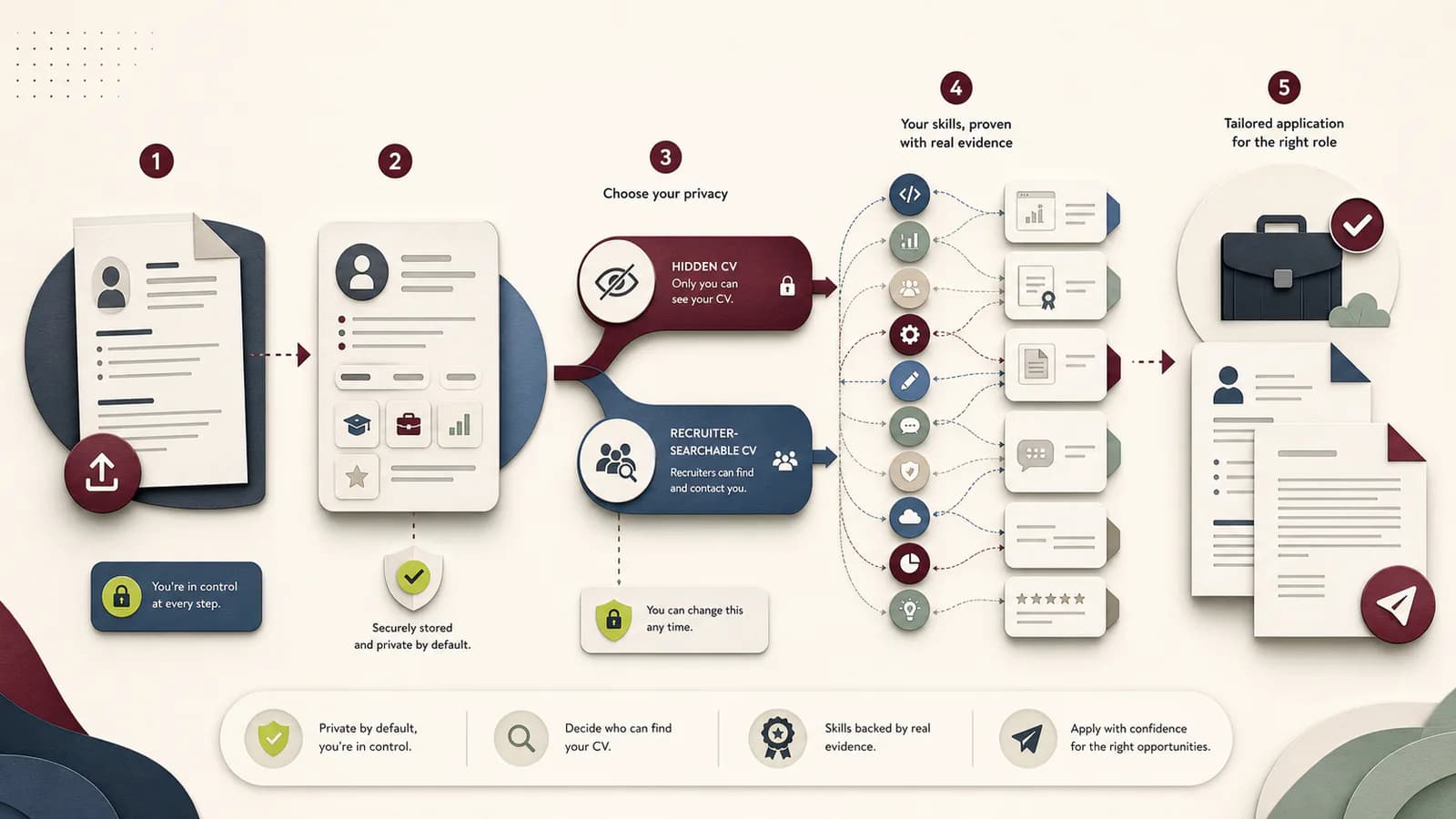
Check current location and work-status requirements, then decide whether recruiters should be able to search the CV.
CheckpointEligibility facts are accurate and the visibility choice matches your intention.
Upload a current CV and reconcile contact details, location, relocation, target direction, and core skills.
CheckpointThe profile remains accurate even when viewed outside a specific application.
Select the most relevant searchable skills and ensure each appears in work, projects, education, or credentials.
CheckpointNo search skill relies on a claim you could not explain to a recruiter.
Read the full advert, select the closest CV evidence, and adapt the editable cover letter to employer and role.
CheckpointThe letter adds motivation or context rather than repeating generic CV lines.
Use the stated route, retain the submitted materials, and track recruiter contact without assuming every message is a fit.
CheckpointYou can connect a recruiter response to the visible profile or exact application.
Before you submit
Recover the missing proof
Common mistakes
Tailoring should change selection, order, and language—not the underlying facts. Keep every claimed skill, scope, credential, and outcome traceable to evidence you can explain.
Choose visibility deliberately and keep only necessary, professional contact and career details.
Select skills supported by a role, project, licence, education, action, or outcome.
Use the editable letter to address the named role and two relevant requirements.
Use the advertiser's contact details because CV-Library directs candidates to the recruiter for role information and feedback.
Limit 01
CV-Library's published location, registration, and work-permit restrictions can change and should be checked on the official help pages.
Limit 02
Search visibility does not guarantee recruiter discovery, contact, an interview, or a job offer, and this tool cannot inspect private search or ranking systems.
Official-source notes
Platform features, file rules, and application flows can change. These notes were last reviewed on . Open the linked first-party guidance before relying on a changing detail.
Official rules for account creation, search visibility, file types and size, contact details, skills, location, and work status.
Verified July 30, 2026
Official guidance on direct applications, Quick Apply, cover letters, confirmations, recruiter contact, and overseas access.
Verified July 30, 2026
My Best Resume is independent and is not affiliated with, endorsed by, or sponsored by CV-Library. CV-Library and its related marks belong to their respective owner.
Compare other application paths
Keep one evidence-rich master resume, then adjust the submitted version for the target role and the application path you will actually use.
Job-site guide
Tailor a UK CV for Reed jobs, control the saved file version, prepare for direct or redirected applications, and verify every submission.
Open the guide →Job-site guide
Prepare a UK CV for Totaljobs, meet its stored-file rules, review one-click apply settings, and tailor evidence before each application.
Open the guide →Job-site guide
Use the new GOV.UK Work Hub to find jobs, build or download a UK CV, and match truthful experience to each employer's application route.
Open the guide →CV-Library resume FAQ
CV-Library's registration help lists DOC, DOCX, and PDF files under 10 MB.
Yes, if the registered CV is not hidden. Review the visibility setting and the information included before enabling discovery.
CV-Library says registered applications normally let you add an editable cover letter, and its help recommends tailoring that letter to the specific vacancy.
Platform rules can change. CV-Library currently publishes location and work-permit restrictions, so verify the official registration and application help before proceeding.
Start with the experience you already have, inspect what the role asks for, and only add claims you can verify. Then carry the target into the full resume workflow.