U.S. job search · 14 minute practical guide
OPT-Friendly Jobs: What International Students Should Look for Before Applying
Check role relevance, employer identity, supervision, E-Verify, Form I-983, start dates, and future sponsorship before calling a job OPT-friendly.
The answer first
“OPT-friendly” is a checklist, not an official employer label.
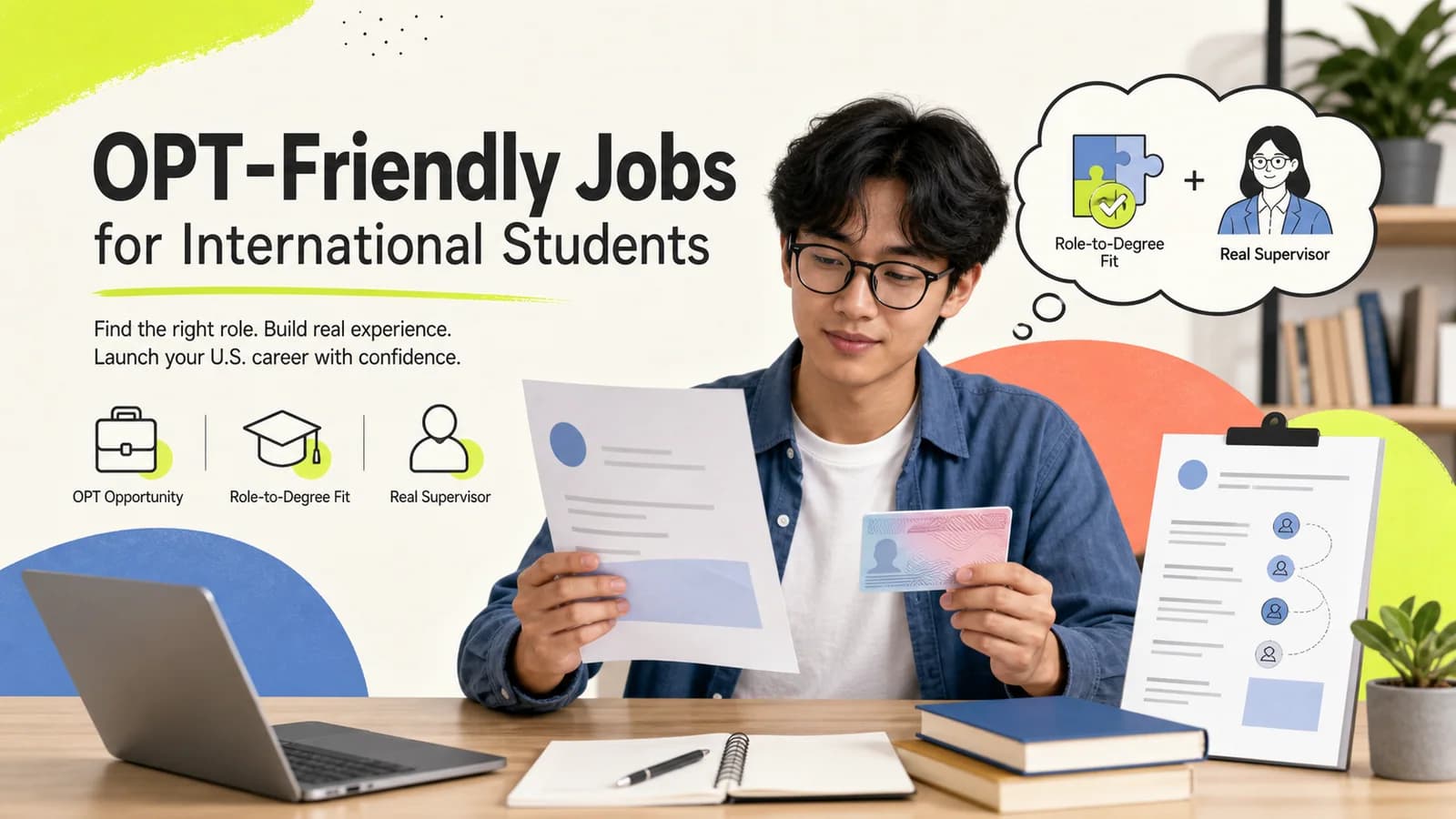
A viable OPT job must fit your current authorization and be directly related to your major. For a STEM OPT extension, the employer must meet additional requirements, including E-Verify participation and a bona fide training relationship documented through Form I-983. Future visa sponsorship is a separate question.
- Degree-to-role relationship
- Actual employer and supervisor
- Dates, hours, and worksite
- STEM OPT and I-983 readiness
Define the term
OPT-friendly should mean the employment can actually comply
Use these checks as a research framework. Individual immigration, employment, and tax conclusions require advice for the actual person, employer, role, and country.
USCIS describes practical training as employment directly related to an F-1 student’s major area of study. Ordinary post-completion OPT may provide up to 12 months of authorization. Eligible students with qualifying STEM degrees may seek a 24-month extension, but that extension brings employer, reporting, and training-plan conditions.
A company can be welcoming to international graduates yet offer a role that is unrelated to your degree, starts before your Employment Authorization Document permits work, or lacks a compliant STEM training arrangement. The label never overrides the facts.
Swipe horizontally to compare the details.
| Question | Why it matters | Evidence to collect |
|---|---|---|
| How is the work related to my major? | OPT training must be directly related to the degree. | Duties, projects, tools, and a short degree-to-role explanation. |
| Who is my legal employer? | The entity employing, supervising, and paying you affects compliance. | Legal name, EIN if needed, offer letter, and reporting line. |
| When and where will I work? | Authorization dates, hours, worksite, and reporting obligations matter. | Start date, weekly hours, location, and remote-work arrangement. |
| Is the employer ready for STEM OPT? | STEM OPT has E-Verify, I-983, training, and reporting requirements. | E-Verify confirmation and the employer’s I-983 process. |
Degree relationship
Write the degree-to-role explanation before the interview
- Map three to five core duties to courses, research, technical methods, or domain knowledge from the degree.
- Prefer postings with concrete responsibilities over generic “business support” or “wear many hats” descriptions.
- Ask your designated school official how your school expects the relationship to be documented; the employer does not make the final immigration determination.
- Keep the explanation accurate. Adding technical keywords to an unrelated job does not create a genuine relationship.
STEM OPT
Check the employer, not just the brand name
Use these checks as a research framework. Individual immigration, employment, and tax conclusions require advice for the actual person, employer, role, and country.
The employer must be enrolled in E-Verify and in good standing, have a valid Employer Identification Number, provide a formal training experience, offer duties, hours, and compensation comparable to similarly situated U.S. workers, report certain changes, and work with the student on Form I-983.
Staffing and consulting arrangements need special attention. USCIS focuses on whether the entity signing the training plan is the bona fide employer that provides and oversees the training. A placement at a client site does not automatically fail, but a paper employer that cannot supervise or fulfill the plan is a serious warning.

Recruiter questions
Ask operational questions before you invest in the process
Use these checks as a research framework. Individual immigration, employment, and tax conclusions require advice for the actual person, employer, role, and country.
Use the federal E-Verify search as one check, but read its caveats: participation records can appear under legal or trade names and the search may not capture every location or account. Ask the employer to confirm its own enrollment.
- What legal entity would employ me, and who would supervise my work?
- Is the employer enrolled in E-Verify under that legal name?
- For STEM OPT, has the employer completed Form I-983 with employees before, and who signs and manages evaluations?
- Can the role start on or after my authorized date, at the required hours and location?
- Does the employer support future immigration sponsorship? Treat this as separate from permission to work on OPT.
Offer-stage review
Recheck the arrangement when the opportunity becomes concrete
Use these checks as a research framework. Individual immigration, employment, and tax conclusions require advice for the actual person, employer, role, and country.
Compare the final title and duties with the role you used to explain degree relevance. Confirm that the offer comes from the same legal employer discussed during recruiting and that the start date does not precede authorization. If the work is remote or at a client site, document who directs the work, how supervision occurs, and where required evaluations will happen.
For STEM OPT, ask who will collaborate on Form I-983, who has authority to sign it, and how the employer handles the required self-evaluations and material changes. A generic promise from a sales recruiter is not a substitute for the actual employer’s ability to deliver and oversee the training described.
Discuss compensation and hours plainly. USCIS says STEM OPT terms must be commensurate with those of similarly situated U.S. workers, and the training opportunity cannot replace a U.S. worker. Unpaid, nominally paid, or unusually structured work deserves individual review before acceptance.
- Keep the offer, EAD dates, degree-to-role explanation, I-983, evaluations, and employer contacts in one secure record.
- Report employment and material changes through the process your DSO requires; do not assume the employer reports everything for you.
- If the job changes before start, pause and re-evaluate rather than treating the original analysis as permanently valid.
Risk screen
Pause when the arrangement is hard to identify or explain
- The employer will not identify the legal employing entity or supervisor.
- The recruiter promises that “any job counts” for OPT or asks you to create duties that are not real.
- A third party will sign the I-983 but cannot describe the training, oversight, or evaluation process.
- The proposed start date precedes work authorization, or the job details conflict with your authorized conditions.
- The company says E-Verify automatically means it will sponsor an H-1B later.
Common questions
Short answers before you act
- Is every E-Verify employer OPT-friendly?
- No. E-Verify participation is one STEM OPT employer requirement, not a complete evaluation. The job must still relate directly to the degree, dates and hours must fit the authorization, and the real employer must provide the required supervision, training, reporting, and Form I-983 support.
- Can an OPT or STEM OPT job be remote?
- Remote work is not evaluated by the word “remote” alone. The employer, degree relationship, worksite reporting, hours, supervision, training, and ability to carry out the I-983 must be genuine and documented. Confirm your specific arrangement and reporting duties with your DSO.
- Can I accept an unpaid job on OPT?
- Compensation rules depend on the authorization and employment facts. STEM OPT expressly requires commensurate compensation and a bona fide training relationship. Before accepting unpaid, volunteer, nominally paid, or self-directed work, obtain advice for your program and status rather than relying on a recruiter’s label.
- Does working on OPT mean I do not require sponsorship?
- OPT is present work authorization and ordinarily does not require an employer petition to start, but an employer may have STEM OPT obligations. If continued U.S. employment after OPT would require an employer petition, the truthful answer to “now or in the future” may still be yes.
Continue the research
Related U.S. job-search guides
- Answer “now or in the future?”
Explain OPT authorization without hiding a future need.
- Verify a sponsorship claim
Rank current and historical evidence.
- Audit pre-screen rejection risks
Understand application questions before resume review.
Editorial method
Reviewed July 28, 2026. We prioritized current U.S. government and university career-center material, separated historical data from present employer policy, and avoided predicting individual immigration outcomes. This educational guide is not legal, tax, or employment advice.
Sources reviewed
- USCIS practical training chapter
Official OPT and STEM OPT eligibility and employer responsibilities.
- ICE practical training
SEVIS guidance for F-1 practical training.
- Study in the States Form I-983 overview
Training-plan purpose, responsibilities, and evaluations.
- E-Verify employer-search caveats
Limits of treating a public employer search as conclusive.
Make the degree-to-role relationship visible.
After confirming that the opportunity can work for your status, map the job’s real requirements to verified coursework, projects, skills, and experience.