U.S. job search · 12 minute practical guide
Why International Candidates Get Rejected Before the Resume Review
See how work-authorization, sponsorship, location, credential, and application-rule questions can stop a candidacy before a recruiter reads the resume.
The answer first
The resume may never be the first decision.
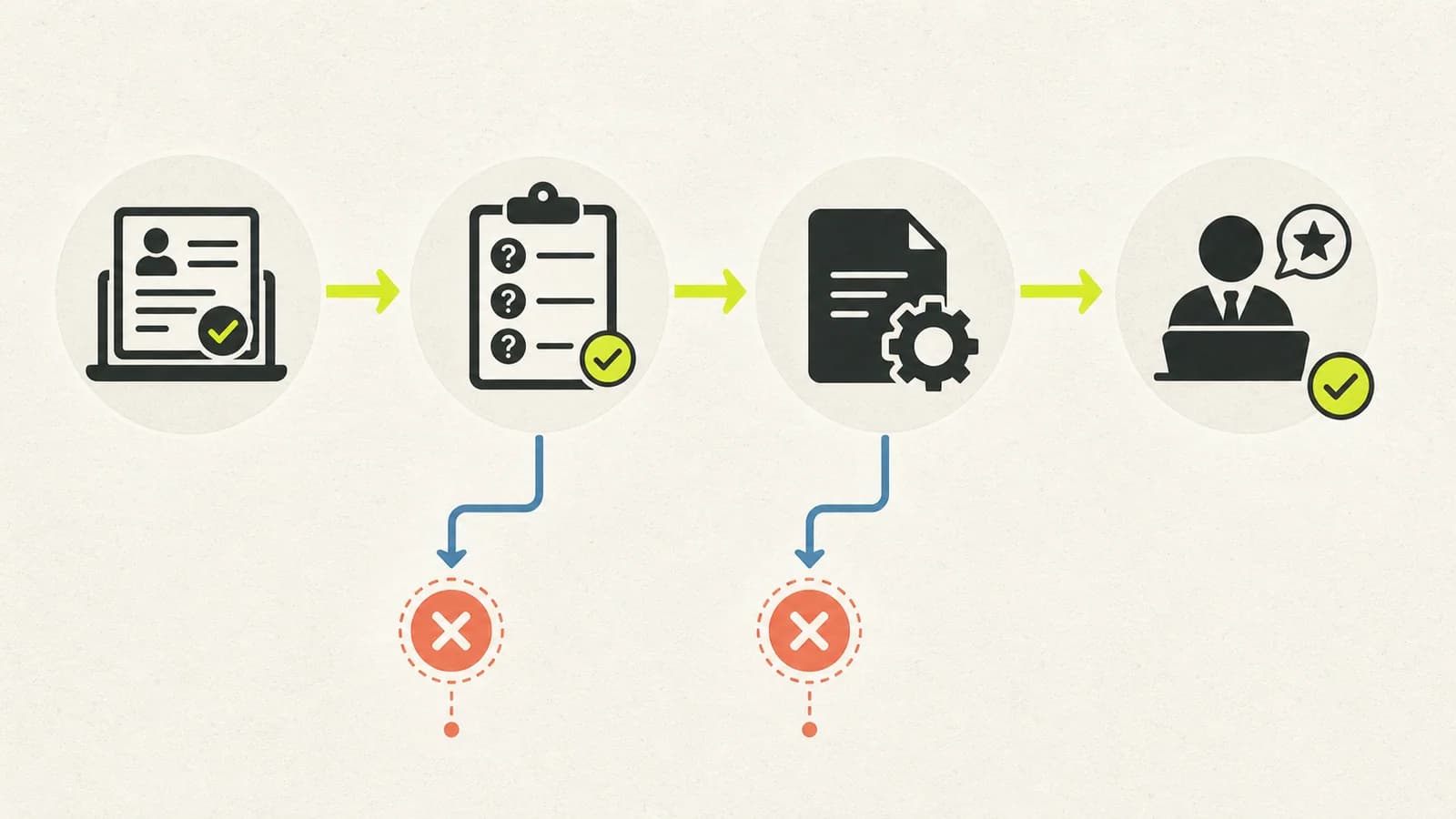
Many application systems can route or reject candidates using employer-defined questions before a recruiter reviews the resume. Work authorization and sponsorship are only two possible gates; location, schedule, required credentials, security clearance, application completeness, and other minimum qualifications may also decide the workflow.
- Knockout questions
- Location and schedule
- Authorization and sponsorship
- Required credentials

Application workflow
Separate pre-screening, resume parsing, and human review
Use these checks as a research framework. Individual immigration, employment, and tax conclusions require advice for the actual person, employer, role, and country.
Greenhouse, SAP SuccessFactors, Oracle, and other recruiting platforms document prescreening or application-rule features. The employer chooses the questions and outcomes. The software does not independently decide immigration policy.
Swipe horizontally to compare the details.
| Layer | What may happen | What to inspect |
|---|---|---|
| Submission | Incomplete fields, missed assessments, duplicate profiles, or a closed requisition prevent a valid application. | Confirmation page, email receipt, employer career portal, deadline. |
| Application rules | A yes/no or multiple-choice response routes or rejects the application. | Exact wording, required answer, employer policy, and your truthful facts. |
| Resume processing | The system extracts contact, role, education, skill, and date information. | Readable file, plain-text extraction, consistent dates and headings. |
| Human review | A recruiter compares the application with the role, evidence, and hiring context. | Target fit, relevant proof, clarity, and competition. |
Common gates
Read minimum requirements before optimizing keywords
- Current work authorization or willingness to sponsor now or later.
- Physical location, ability to work on-site, commuting distance, time zone, or relocation timing.
- Required license, certification, degree, language, years of experience, or legal age.
- Security-clearance eligibility, government-contract requirements, or lawful export-control conditions.
- Shift, travel, compensation, or start-date availability.
- Completion of an assessment, portfolio, supplemental question, or referral step.
International-candidate questions
Do not answer “no sponsorship” when the truthful answer is “later”
Use these checks as a research framework. Individual immigration, employment, and tax conclusions require advice for the actual person, employer, role, and country.
A student on valid OPT may be authorized to work now while still needing employer sponsorship to continue later. Answering “no” to a combined future-sponsorship question to bypass a filter creates an inconsistency. The right response depends on the exact wording and your actual situation.
Employer policy may allow some categories, occupations, levels, or locations but not others. If an answer field is ambiguous and the role is otherwise strong, use a permitted explanation field or contact recruiting. Keep a copy of the form and your response.
Application audit
Create a clean record before calling the resume the problem
Use these checks as a research framework. Individual immigration, employment, and tax conclusions require advice for the actual person, employer, role, and country.
- Open the current posting on the employer’s own career site and confirm the requisition is still active.
- Save the posting, required qualifications, location, sponsorship language, and requisition ID.
- Review every submitted answer, especially authorization, future sponsorship, location, degree, license, and years-of-experience questions.
- Confirm the uploaded document opens, contains selectable text, and uses the same dates and titles as the form.
- Record the submission and rejection times, but treat timing as a clue rather than proof.
- Compare outcomes across similar roles and requirements before changing the resume.
Search experiment
Use patterns across comparable applications, not one rejection email
Use these checks as a research framework. Individual immigration, employment, and tax conclusions require advice for the actual person, employer, role, and country.
Create a log with requisition, legal employer, job family, level, location, on-site requirement, sponsorship language, required credentials, application answers, resume version, source, submission time, and outcome. Do not store sensitive identity documents in the log. The purpose is to see where the search changes.
If applications with an explicit “no future sponsorship” statement reject while similar sponsor-open roles reach screens, the pattern supports an eligibility-targeting problem. If sponsor-open roles reach human review but do not advance, investigate role fit and resume evidence. If every application stops immediately, first confirm submission completeness and answer consistency.
Change one meaningful variable at a time for the next set: employer policy, application channel, target level, location, or resume evidence. A simultaneous rewrite, new job family, new city, and new answer strategy produces no clean lesson.
Check whether a job-board application truly reached the employer. Some listings redirect to a second form, expire while remaining visible on an aggregator, or create a profile without completing the requisition. The authoritative confirmation is normally the employer portal or receipt tied to the requisition—not a generic “application started” message.
Finally, separate employer preference from a legal restriction. A company may decline sponsorship as policy; another role may carry a lawful clearance, export-control, license, or government-contract condition. The candidate should read the exact requirement and use official rights guidance when treatment appears improper, rather than assuming every restriction has the same legal basis.
- Never test a theory by entering an untruthful answer.
- Do not treat a small sample as proof that every employer or recruiting platform behaves the same way.
- If a rejection notice identifies a reason, preserve the exact wording; do not replace it with an assumed ATS explanation.
- Review the experiment after a defined set of comparable applications or a fixed period, not after every emotionally difficult result.
What you can improve
Fix the controllable layer without falsifying the uncontrollable one
Prioritize postings whose location, employment structure, minimum credentials, and sponsorship policy fit your facts. Apply through the employer site when possible, submit complete fields, and tailor the resume to genuine required work.
If you suspect citizenship-status or national-origin discrimination, an unfair documentary practice, or an inaccessible application process, use official DOJ, EEOC, or accommodation channels. Do not infer illegality solely from a rejection.
Common questions
Short answers before you act
- Does an instant rejection prove the application was auto-rejected?
- No. Speed is a clue, not proof. An employer rule may have acted on an answer, but a recruiter may also review quickly, the requisition may have closed, or the submission may be incomplete. Inspect the posting, answers, portal status, and comparable applications.
- Can ATS keywords fix a sponsorship knockout question?
- No. Resume wording cannot change a truthful authorization, location, license, or sponsorship answer. First target roles whose minimum requirements and policy fit. Then improve resume parsing and evidence if the application can reach document or human review.
- Should I answer “no” to sponsorship so a recruiter sees my resume?
- Never submit an answer you know is false. It can create contradictions later and does not change the employer’s policy or your need. If the question is ambiguous, use an explanation field or contact recruiting, and obtain individual advice when the legal meaning is unclear.
- Can I ask the employer why I was rejected?
- You can ask politely, but many employers will not provide an individualized reason. Treat any response as information about that requisition, not a universal rule. If you suspect prohibited discrimination or an accessibility problem, use official worker-rights or accommodation channels.
Continue the research
Related U.S. job-search guides
- Answer authorization questions accurately
Separate present permission and future employer action.
- Run the full no-interview diagnostic
Separate eligibility, strategy, evidence, and market constraints.
- Test the resume’s first read
Use this after confirming the application reached resume review.
Editorial method
Reviewed July 28, 2026. We prioritized current U.S. government and university career-center material, separated historical data from present employer policy, and avoided predicting individual immigration outcomes. This educational guide is not legal, tax, or employment advice.
Sources reviewed
- Greenhouse auto-reject rules
How employer-configured application answers can trigger rejection.
- Greenhouse application rules
Platform documentation for routing candidate applications.
- Oracle prescreening questions
Enterprise recruiting documentation for disqualification questions.
- DOJ IER frequently asked questions
Official guidance on authorization, sponsorship, and worker rights.
Diagnose the right layer before rewriting.
If eligibility and application answers fit, analyze whether the resume makes the target role, level, skills, and evidence easy to find.