Job Profile and visibility
Candidates can store a CV and career information, then decide whether the profile supports employer discovery.
Job-site resume guide
Trade Me Jobs uses a Job Profile to support applications and, when made visible, employer discovery. The profile can store a CV and career information, while New Zealand applications commonly require a short, role-specific cover letter alongside the CV.
My Best Resume is independent and is not affiliated with, endorsed by, or sponsored by Trade Me Jobs. Trade Me Jobs and its related marks belong to Trade Me Limited or their respective owner.
Live evidence check
Paste the complete listing from Trade Me Jobs. The matcher separates direct support, adjacent experience, missing evidence, and hard requirements so you can decide what to emphasize without inventing a qualification.
Two-document evidence workspace
Supported
Direct resume evidence
Transferable
Related, not equivalent
Missing
A question, not a rewrite
Requirements
Not verified in the resume
Platform overview
Trade Me Jobs is a New Zealand employment marketplace within Trade Me. Its Job Profile can store career information and a CV for applications and, when made visible, employer discovery. Listings can use Apply online or provide other approved employer instructions.
New Zealand applications commonly pair a concise CV with a tailored cover letter. The CV should prove relevant capability and outcomes; the letter can explain motivation, connection to the organisation, and selected evidence. Overseas experience should be made understandable without renaming titles or claiming local credential equivalence.

Candidates can store a CV and career information, then decide whether the profile supports employer discovery.
The two documents divide evidence from role- and organisation-specific motivation and context.
Search covers local employers, regions, work types, industries, and practical location or availability needs.
Hiring landscape
Trade Me Jobs covers the Aotearoa New Zealand labour market. These are representative hiring clusters, not a live ranking.

Swipe the table to compare all columns →
| Job category | Why it fits this platform | What the resume should prove |
|---|---|---|
| Construction, trades, and property | Local and project roles can depend on trade, registration, licence, site, tool, travel, and region. | Name exact credentials, project type, tools, safety, quality, team scope, and completed work without claiming NZ equivalence. |
| Healthcare and community services | Employers recruit across clinical, care, disability, social, community, and operational services. | Surface registration status, checks, people supported, cultural and community context, safeguarding, and outcomes. |
| Technology, finance, and business | Professional roles span software, data, accounting, sales, operations, administration, and management. | Explain unfamiliar employers or markets, then show systems, ownership, stakeholders, scale, and measurable results. |
| Transport, manufacturing, and primary industries | Roles may specify licence, equipment, shift, region, season, safety, production, and practical availability. | Quantify routes, stock, output, equipment, safety, quality, reliability, and environmental or operational improvement. |
| Retail, hospitality, and customer service | Local employers often value availability, service, community knowledge, reliability, and team contribution. | Show schedule fit where useful, customer volume, sales or service quality, teamwork, training, and dependable delivery. |
Category availability changes by location, date, eligibility, and employer demand. Always verify the live listing before applying.
Direct answer
Build a current Trade Me Job Profile, upload a clear New Zealand CV, and choose visibility deliberately. Tailor both the CV and a one-page cover letter to the advert: explain the relevant evidence, why this role and organisation make sense, and any factual location or work-rights context the employer requests. Use the Apply online route or the explicit contact instructions shown in the listing.
Who this guide is for
Best for people applying to roles across Aotearoa New Zealand through Trade Me Jobs, including candidates translating overseas experience into local context.
Application patterns
A job site can host the discovery step, the application step, or both. The resume should remain readable when the employer moves it into another workflow.
A Trade Me Job Profile and stored CV support applications sent through the listing's online flow.
Resume implicationReview the profile, selected CV, cover letter, contact details, and any questions as one coherent application.
Some listings give named contact instructions or use an approved external application link.
Resume implicationFollow the advertiser's stated route and verify the destination rather than assuming the profile completed the application.
A candidate can make the profile visible so employers may contact them about opportunities.
Resume implicationKeep the public-facing profile and CV current, relevant, and free of unnecessary sensitive information.
Resume priorities
Platform mechanics are only one constraint. A recruiter still needs a clear target, credible experience, and evidence that connects to this particular posting.

Local employers should understand responsibilities, team style, and outcomes without decoding overseas context.
Which employer, title, qualification, or market scale needs a short factual explanation?
The CV records evidence, while the cover letter explains specific motivation and fit.
Which two examples belong in the CV, and which one should the letter connect directly to this employer?
A visible Job Profile can invite employer contact outside a submitted application.
What profile facts and CV details are appropriate for employer discovery?
New Zealand employers often value clear collaboration, reliability, and community or customer context when those qualities are evidenced.
What action shows how you worked with colleagues, customers, iwi, community, or stakeholders rather than merely claiming fit?
Job-search tutorial
Follow the platform-specific path below, then use the checkpoint at each stage to catch a bad fit, missing proof, or wrong document before submission.
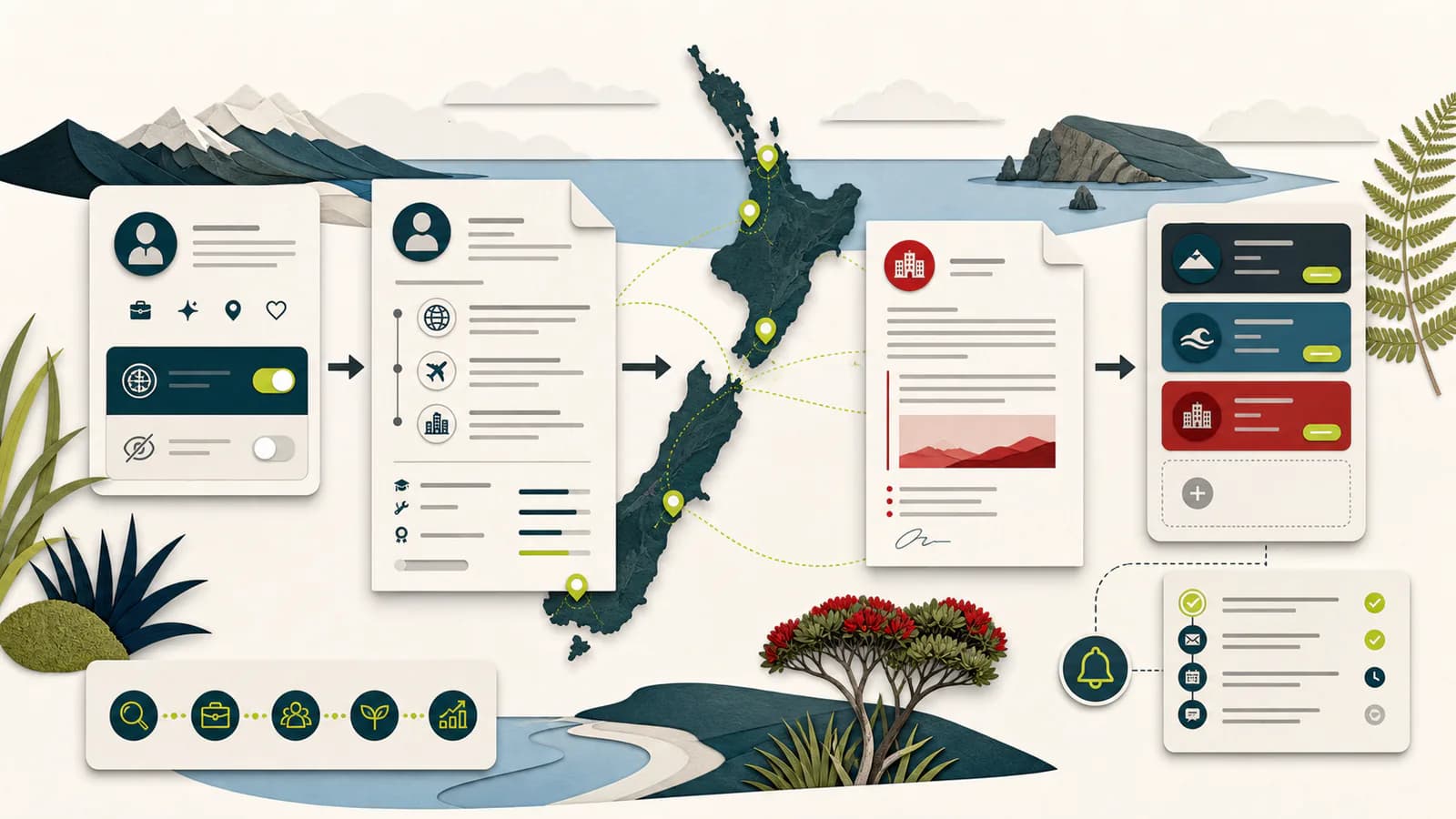
Check employer, location, work type, schedule, responsibilities, requirements, and the exact Apply route.
CheckpointYou understand both the work and the practical conditions.
Keep original titles and credentials while adding neutral context for organisation, market, responsibility, and scale.
CheckpointA New Zealand employer can understand comparability without a false local claim.
Use the CV for evidence and the short cover letter for motivation, employer connection, and two or three selected examples.
CheckpointThe two documents complement each other instead of repeating the same introduction.
Update stored facts and CV, then choose profile visibility based on whether you want employer discovery.
CheckpointThe profile, submitted CV, and letter share the same factual history and target.
Use Apply online or the listed employer instruction, save the package, and record any follow-up contact.
CheckpointYou can identify what was sent, to whom, through which route, and when.
Before you submit
Recover the missing proof
Common mistakes
Tailoring should change selection, order, and language—not the underlying facts. Keep every claimed skill, scope, credential, and outcome traceable to evidence you can explain.
Write a one-page letter for the named role and organisation with one or two verified examples.
Use the letter to connect selected evidence to the employer, not retell the entire history.
Review contact information, work history, attributes, CV, and visibility before employer discovery.
Read the listing's contact and destination instructions and retain the final confirmation.
Limit 01
Trade Me listings can use different employer contact or application routes, so the live listing controls the final requirements.
Limit 02
This guide cannot verify work rights, qualification recognition, employer identity, profile discovery, or a hiring outcome.
Official-source notes
Platform features, file rules, and application flows can change. These notes were last reviewed on . Open the linked first-party guidance before relying on a changing detail.
Trade Me's official steps for creating, editing, adding a CV to, and setting visibility for a Job Profile.
Verified July 30, 2026
Official search, saved-search, profile, application, and overseas-worker resource guidance.
Verified July 30, 2026
Current Trade Me Jobs guidance on tailored one-page cover letters and local application context.
Verified July 30, 2026
My Best Resume is independent and is not affiliated with, endorsed by, or sponsored by Trade Me Jobs. Trade Me Jobs and its related marks belong to Trade Me Limited or their respective owner.
Compare other application paths
Keep one evidence-rich master resume, then adjust the submitted version for the target role and the application path you will actually use.
Job-site guide
Tailor an Australian resume for SEEK, align it with your profile, choose visibility deliberately, and verify the file sent with each job application.
Open the guide →Job-site guide
Tailor a CV for jobs.govt.nz, map evidence to public-service criteria, follow each agency's application route, and verify work rights separately.
Open the guide →Job-site guide
Tailor a student or graduate CV for SJS New Zealand, verify eligibility, turn study and casual work into evidence, and track focused applications.
Open the guide →Trade Me Jobs resume FAQ
Trade Me's help says the Job Profile is used to apply to jobs on the platform. Create it, add a current CV, and review its visibility and details.
Trade Me's current career guidance recommends a tailored cover letter with each application, normally kept to one A4 page.
Yes, if you choose to make the Job Profile visible. Review what is stored in the profile and CV before enabling discovery.
No. It helps compare the CV and advert. You still update the Job Profile and send the application through Trade Me or the employer's stated route.
Start with the experience you already have, inspect what the role asks for, and only add claims you can verify. Then carry the target into the full resume workflow.